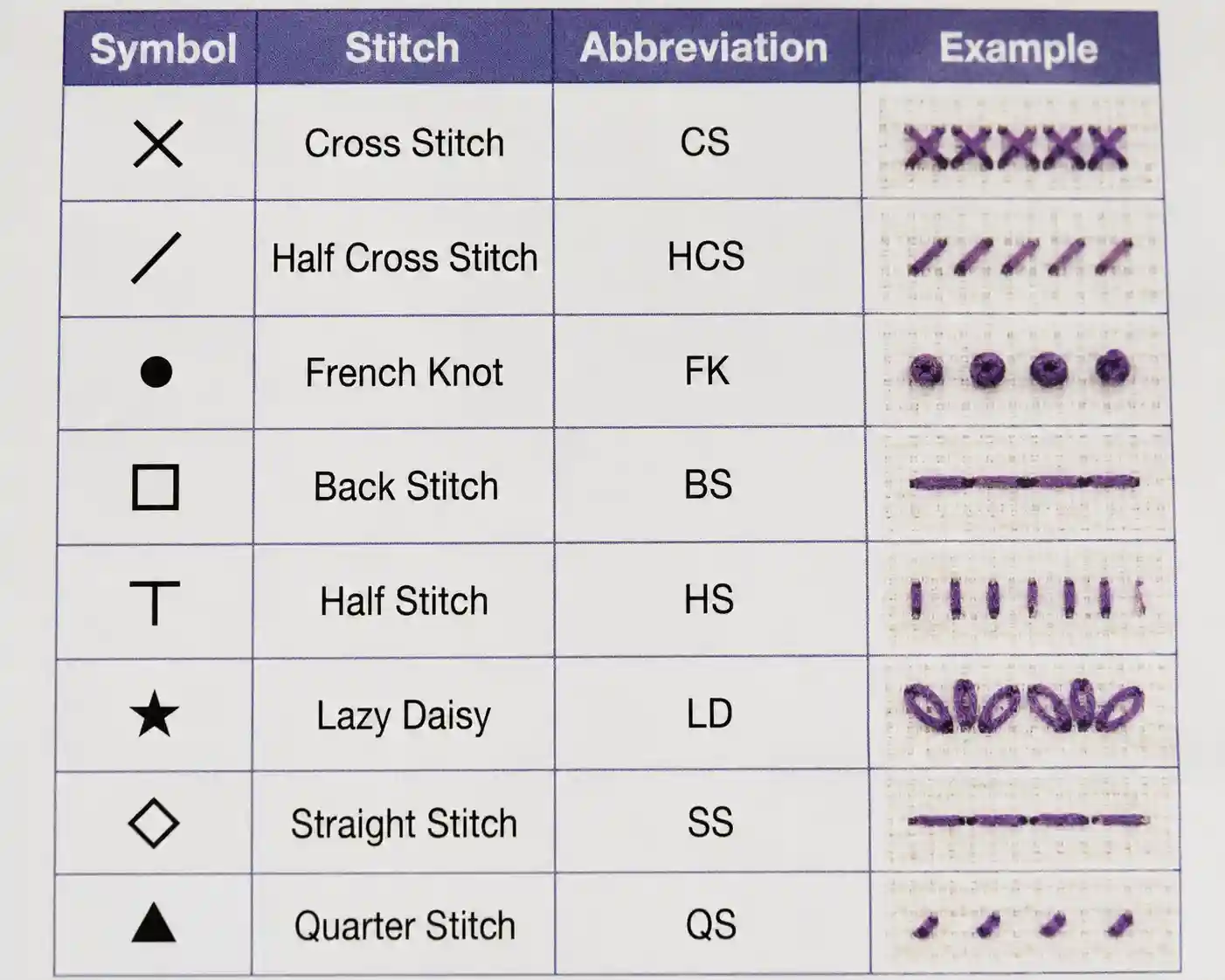
Cross-stitch charts lean hard on shorthand, and once you know it, a key that looked cryptic at first glance becomes completely routine. This page is the reference I'd have wanted bookmarked when I started - keep it open the first few times you sit down with an unfamiliar chart.
Stitch type abbreviations
- XSt / CSt - Cross stitch (full cross stitch), the base of nearly every design.
- 1/2 XSt - Half cross stitch, a single diagonal only.
- 1/4 XSt - Quarter stitch, a small fractional stitch used for curves and fine detail.
- 3/4 XSt - Three-quarter stitch, a full diagonal plus a quarter - see quarter and three-quarter stitch for how these actually get worked.
- BS - Backstitch, shown as a solid line drawn over the grid rather than filled into a square - see backstitch.
- FK - French knot, usually marked as a dot or small circle not aligned to the grid - see French knot.
- LS - Long stitch, a loose straight stitch of variable length.
Thread and color abbreviations
- DMC / ANC - Indicates which floss brand's numbering the key is using (DMC or Anchor) - see the floss guide if you need to convert between them.
- 2 str / 3 str (or just a number before "strand") - How many strands of six-strand floss to use for that section. Cross stitch on 14-count Aida is commonly worked with 2 or 3 strands; backstitch usually uses fewer strands than the surrounding cross stitch.
- Blend / Blended - Indicates two different floss colors should be threaded and stitched together as one, usually for a subtly mixed shade.
Layout and counting terms
- WOT - shorthand some designers use for "work over two," meaning each stitch spans two threads of evenweave or linen fabric rather than one square of Aida - not a universal abbreviation, so check a chart's own key if it uses different shorthand - see working over two threads.
- Center point / centre marker - An arrow or highlighted square on a chart's edge marking the horizontal and vertical middle of the design, used to find your starting point.
- Parking - Temporarily carrying an unfinished thread at the back of the work to pick up again later - see parking vs looping vs stringing.
Common symbol conventions
Charts printed for black-and-white reproduction almost always use symbols rather than color alone, so the same design stays legible without a color printer. A few conventions show up repeatedly across different designers' charts:
- A filled or solid symbol (square, triangle, dot) usually indicates a stitch to be worked in that color.
- An empty or outlined symbol sometimes marks an area intentionally left unstitched (common in Assisi work, where the background stays open and the motif is the unstitched space).
- A symbol split diagonally in half indicates a half or quarter stitch, oriented to match the direction shown.
If a specific chart uses a symbol or abbreviation not covered here, check that chart's own key first - while most of the above is fairly standardized across the hobby, individual designers do occasionally invent their own shorthand for something unusual, and the printed key on your specific chart is always the final authority.