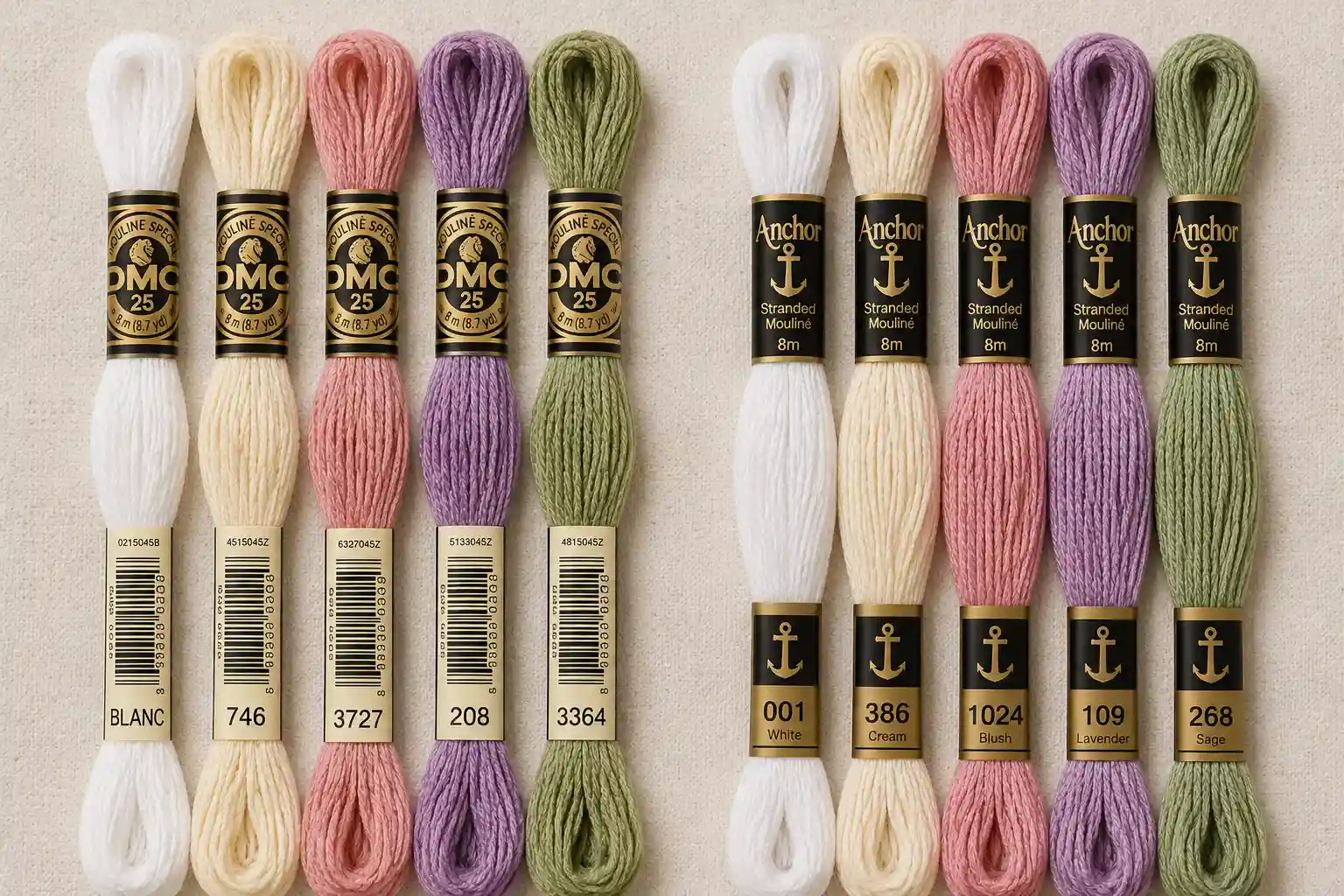
If you've ever had a chart calling for a DMC color you don't own, but a drawer full of Anchor floss instead, this is the page (and the converter tool) that solves it - I built both after one too many stalled projects waiting on a color I already owned under a different name. Here's what I actually think you need to know about the major floss brands and how their numbering works.
Six-strand cotton, the default
The vast majority of cross-stitch charts are written for standard six-strand mercerized cotton embroidery floss - a loosely twisted bundle of six thin strands that can be separated and recombined, letting you stitch with exactly the thickness a design calls for (usually two or three strands on Aida, fewer on finer fabric - see how to read a cross-stitch pattern for how a chart's key specifies this). Both DMC and Anchor, the two dominant brands, sell floss in this same six-strand format, which is exactly why cross-referencing between them is possible in the first place.
DMC
DMC (Dollfus-Mieg et Compagnie), a French company, is the most widely used floss brand worldwide and the one most modern charts are written against by default. Its numbering system uses a mix of 3- and 4-digit codes (like DMC 310 for black, or DMC 3801 for a deep coral), not organized in any obviously logical sequence - the numbers are historical rather than systematic, so there's no shortcut to memorizing them beyond familiarity.
Anchor
Anchor, a British brand, is the other major supplier, historically especially dominant in the UK and parts of Europe. Anchor uses its own independent numbering system (a code like Anchor 403 for black), unrelated to DMC's numbers even where the actual color is identical or extremely close. Older British charts, and some European kits, are more likely to be written in Anchor numbers than DMC.
Why conversion charts exist, and their limits
Because DMC and Anchor developed their numbering and dye systems independently, there's no mathematical relationship between a DMC code and its closest Anchor equivalent - the only way to know which numbers match is a manually cross-referenced conversion table, built by comparing physical color samples. That's exactly what the DMC–Anchor floss converter on this site does for you. Worth knowing from experience: these conversions are close matches, not identical dye lots - for small projects I've never noticed a difference, but for large single-color areas, mixing in a "close enough" substitute floss can occasionally show under a strong light.
Other brands worth knowing
A handful of other brands turn up on charts and shop shelves less often but are worth recognizing: Madeira (German, popular in parts of Europe, with its own numbering), and various own-brand or budget flosses sold by craft retailers, which typically don't have official DMC/Anchor conversions at all and are best matched to a chart by eye rather than by number. When in doubt, I default to DMC for buying floss to match a chart I don't recognize the numbering system on - it's the one virtually every modern chart designer also has to hand, and my own stash skews heavily DMC as a result.