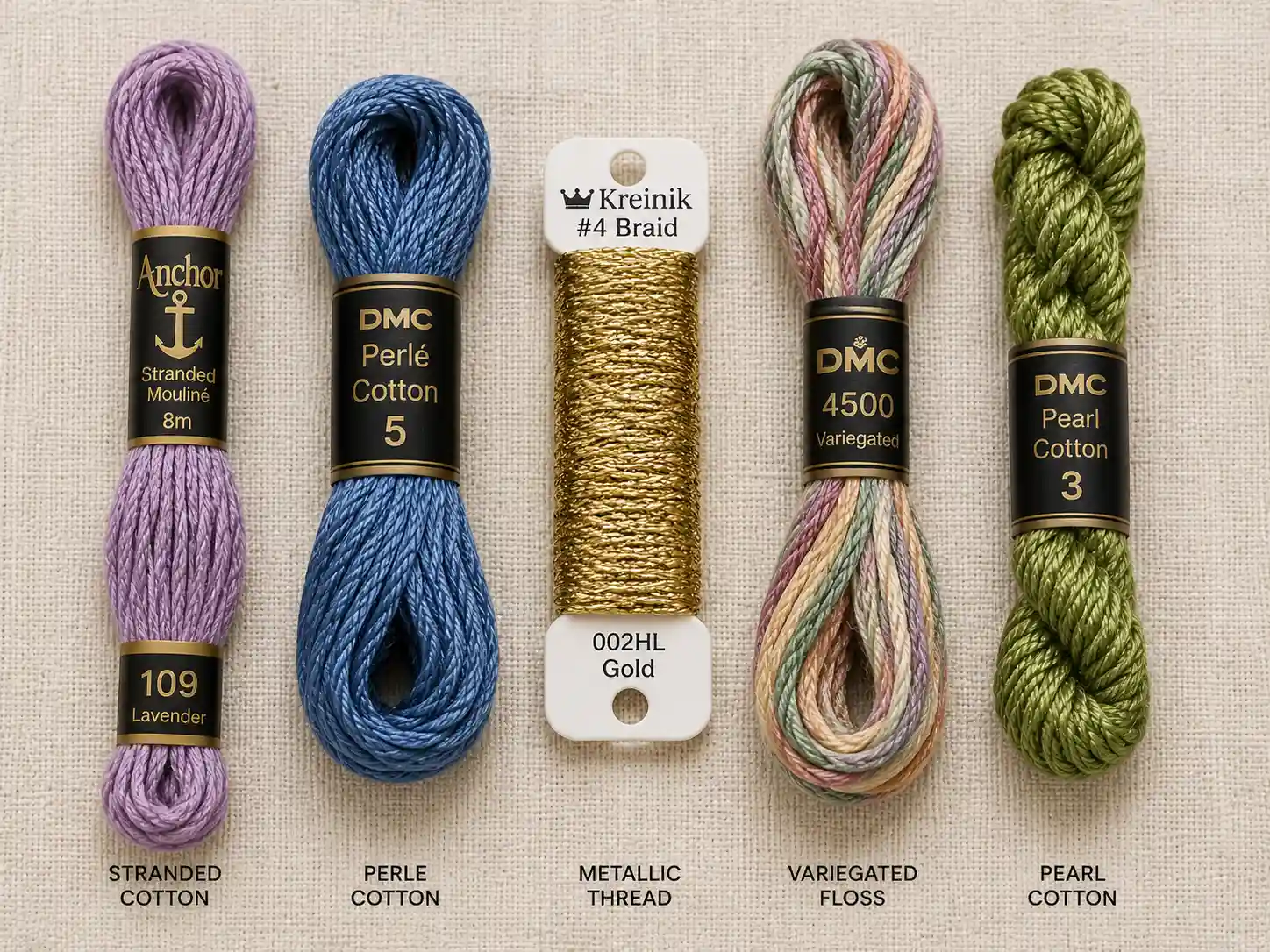
Six-strand cotton floss covers most projects, but it isn't the only thread worth having in a stitching kit. A few specialty threads solve specific problems standard floss doesn't handle as well.
Perle cotton
Perle (or pearl) cotton is a single, twisted, non-divisible strand with a distinctive high sheen - quite different from six-strand floss, which you separate and recombine to control thickness. Because it can't be split, perle cotton comes in graded weights (commonly sizes 3, 5, 8, and 12, with lower numbers meaning thicker thread), and you choose the weight rather than the strand count to control how bold a stitch reads.
Its twist and sheen make it especially good for French knots, where the tighter twist holds a cleaner, more defined knot than floss tends to, and for outline or border work where a slightly raised, glossy line is wanted. It's less commonly used for large fill areas, since it doesn't blend shades the way multi-strand floss can.
Metallic and blending threads
Metallic thread adds sparkle or shine to isolated accents - a highlight, a snowflake, a small detail meant to catch light - but it's genuinely more difficult to work with than cotton floss: it frays and knots more easily and doesn't glide through fabric as smoothly. It's usually best used sparingly and in short lengths rather than for large areas, and often blended with a strand of regular floss (a "blending filament") rather than stitched entirely on its own.
Variegated and hand-dyed threads
Variegated threads shift gradually between shades or colors along their length, giving a naturally blended, painterly effect without you having to manually change floss colors row by row. They're popular for organic subjects - foliage, sky, water - where a single flat color would look too uniform, but they take some planning: because the color shift is fixed along the thread's length, where you start and how you park or carry the thread (see parking vs looping vs stringing) affects exactly where each shade lands in your design.
When specialty thread is worth it
I'd treat these as accent tools rather than default replacements for six-strand floss - a single-color fill of perle cotton, or a project stitched entirely in metallic thread, usually fights the medium rather than working with it. Where specialty thread genuinely earns its place is in small, targeted details: a raised French knot, a glinting highlight, or a naturally shaded patch of foliage that would otherwise need a dozen manual color changes. Blackwork, with its fine geometric linework, is another good place to try perle cotton specifically, since its crisp, twisted texture reads cleanly at the small scale that technique usually works at.