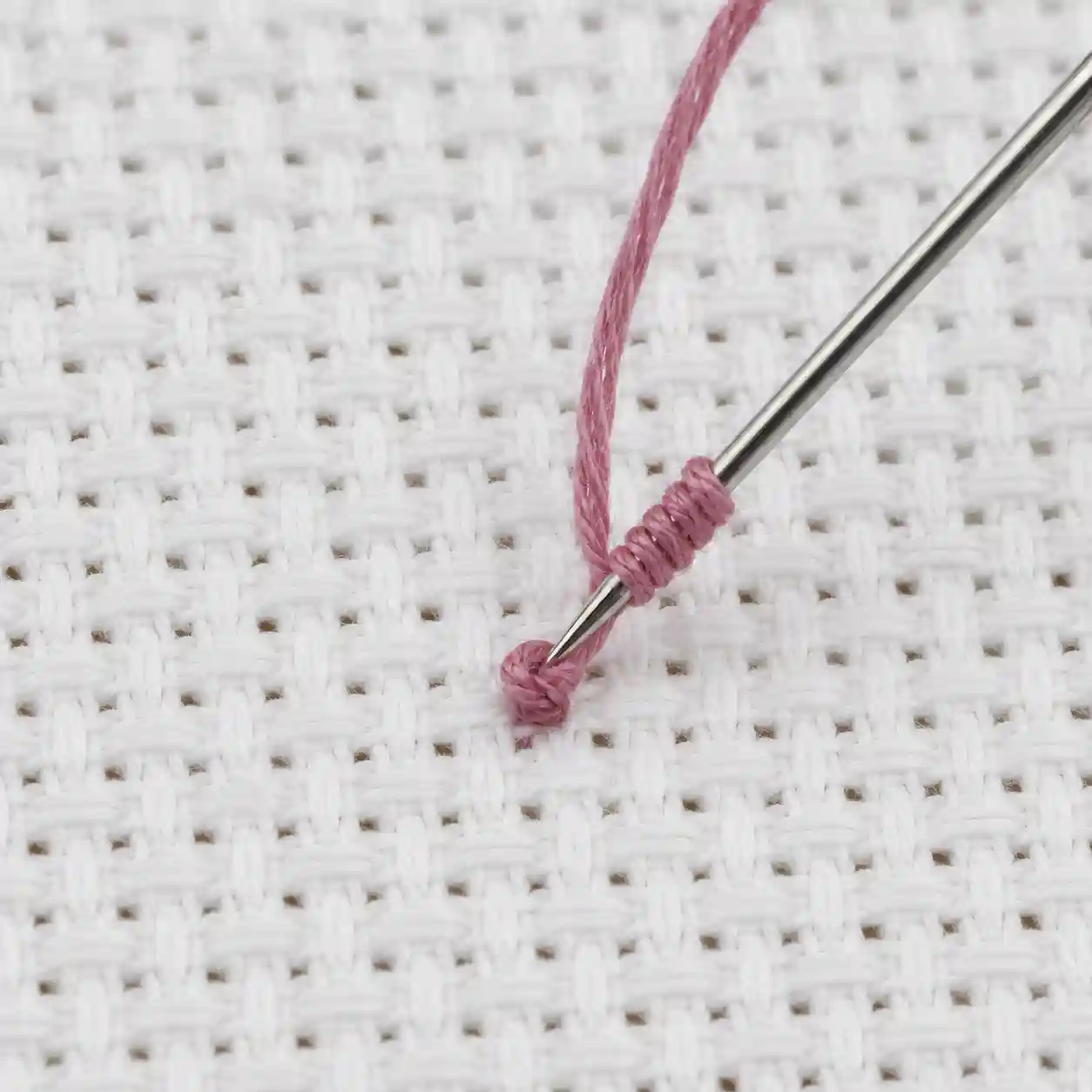
A French knot is a small, raised knot of thread sitting on the surface of the fabric, used as a decorative accent rather than a coverage stitch. It has a reputation as the stitch beginners dread, and honestly, I dreaded it too for longer than I'd like to admit - but the difficulty is almost entirely about thread tension and confidence, not complexity.
How to work it
Up at 1, wrap the needle, down at 2 - a thread's width away, never back into 1.
- Bring the needle up through the fabric at the point where you want the knot.
- Holding the thread taut with your non-stitching hand, wrap it around the needle once or twice (once for a smaller knot, twice for a bolder one).
- Keeping the wraps snug against the needle and the thread taut, insert the needle back down through the fabric very close to - but not into - the point where it came up.
- Hold the wraps in place with your free hand as you slowly pull the needle and thread through to the back. The wraps will cinch down into a small knot sitting on top of the fabric.
Where it goes wrong
- Inserting the needle back into the exact same hole it came up through pulls the knot straight through to the back of the fabric, leaving nothing on the front. Go down a thread's width away from the entry point instead.
- Pulling too fast lets the wraps loosen and unravel before they cinch. Pull slowly and keep light tension on the working thread the whole way through.
- Letting the wraps go slack while you reposition your hands produces a loose, messy knot. Keep tension on the thread from the moment you start wrapping until the knot is fully seated.
It's a stitch that rewards a slow first few attempts on scrap fabric far more than it punishes taking your time on the real piece - I still practice a couple on spare Aida before touching a new project, and it's saved me from picking out a botched knot more times than I can count.
What it's used for
Small raised dots - eyes, flower centers, berries, texture accents, and anywhere a pattern calls for a single point of detail rather than a filled area or a line.