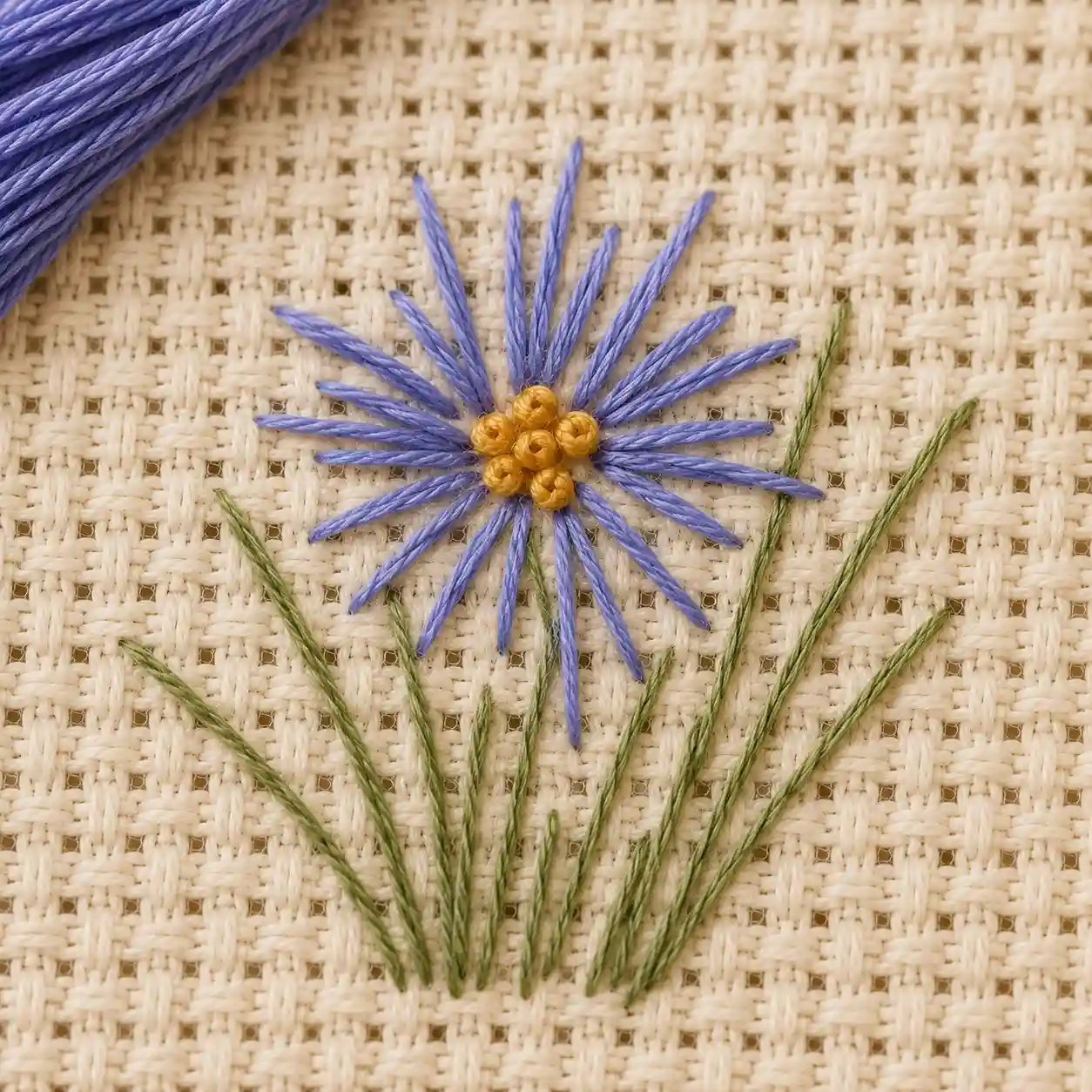
Long stitch is a single straight stitch of variable length, laid directly across the fabric rather than following the fixed grid spacing of a cross stitch, and it's the stitch I reach for whenever I want a piece to loosen up a little. Where backstitch is made of short, uniform, connected segments, long stitch is a single unbroken line that can run any length or angle a design needs.
How to work it
Up at 1, straight down at 2 - any length, any angle. Each stitch stands alone.
- Bring the needle up at the start of the line.
- Insert the needle straight down at the end point - however long or short, and at whatever angle, the design calls for.
- Move to the start of the next stitch and repeat.
Unlike backstitch, long stitches usually don't connect end-to-end into a continuous outline; they're typically worked as individual, separate strokes - think of a starburst pattern or a patch of loose grass, where each stitch is its own mark.
A note on counting
Most cross-stitch charts are built on the assumption that every stitch aligns to the grid. Long stitch is the exception: it's often worked freehand over a marked or charted starting/ending point rather than strictly counted square by square, especially for decorative flourishes layered on top of a mostly-counted design. If a pattern uses long stitch extensively for a realistic or textured effect, read the chart's notes carefully - conventions vary more here than for any other stitch on this list.
Tension and thread choice
Because a long stitch isn't anchored at intermediate points the way a chain of backstitches is, it's more prone to snagging or loosening over time - I've lost a stitch or two to a stray fingernail. Keep tension even but not tight, and I'll often reach for a slightly heavier thread (see perle cotton and specialty threads) for long stitches that need to sit proud of the fabric, like grass or fur texture.
What it's used for
Grass, whiskers, rays of light, hair, and other fine linear details where a single straight stitch communicates the shape better than a filled or outlined area.