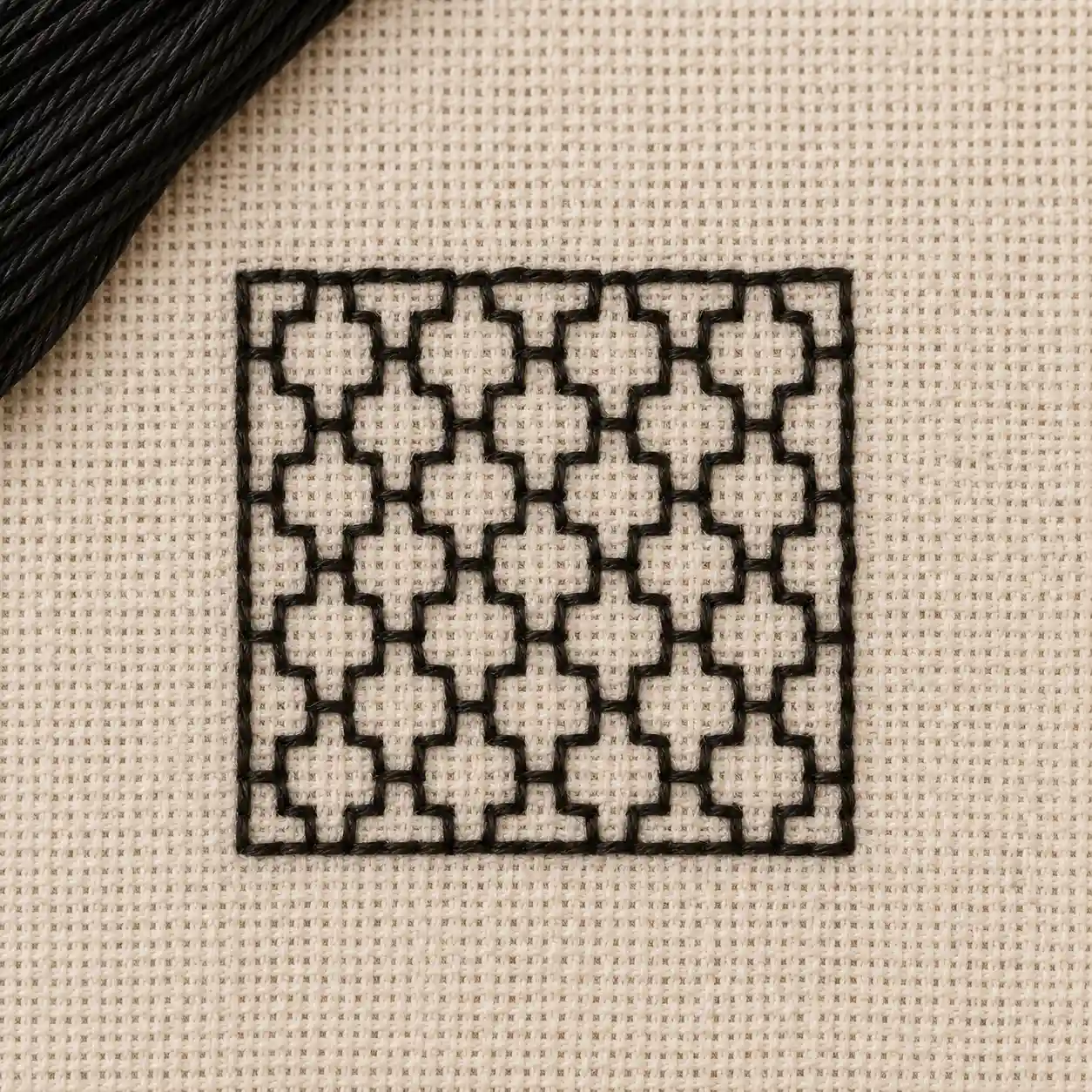
Blackwork is a counted-thread technique built almost entirely from backstitch (or its close relative, double running stitch), traditionally worked in black thread on white or cream linen - hence the name. It's one of my favorite techniques to pull out when I want something graphic without touching color at all. Rather than filling areas with solid color the way cross stitch does, blackwork creates the impression of shading and texture through repeating geometric line patterns of varying density.
The core idea
Instead of one stitch type covering an area, blackwork areas are built from small repeating geometric units - a diamond lattice, a zigzag, a grid of crosses - stitched in outline only. Denser, more elaborate patterns read as "darker" from a distance; simpler, more open patterns read as "lighter." A blackwork design is essentially shading achieved through pattern density rather than color value.
Double running stitch
Historically, blackwork favored double running stitch (also called Holbein stitch) over plain backstitch, because it's fully reversible - it looks identical on the front and back of the fabric, which mattered when blackwork trimmed cuffs and collars that could be seen from both sides. It's worked in two passes:
- Work a row of running stitch (up, over a gap, down, over a gap) along the pattern line, leaving evenly spaced gaps.
- Work back along the same line in the opposite direction, filling in the gaps you skipped the first time.
The result is a continuous line built from two interlocking passes rather than one, with no threads crossing on the back.
A simple diamond lattice - one of blackwork's classic repeating fill patterns, in outline only.
Getting started
Blackwork rewards a fabric with a very regular, visible weave - linen or a high-count evenweave is traditional, since the geometric fill patterns depend on consistent, countable spacing to read cleanly. I'd start with a small, single repeating fill pattern before attempting a design that shades across several density levels - the counting discipline is the main skill I'd want you to build first, before anything more ambitious.
What it's used for
Geometric fill patterns and outline work, traditionally monochrome - borders, historical reproduction samplers, and modern minimalist or geometric designs that want texture without color.