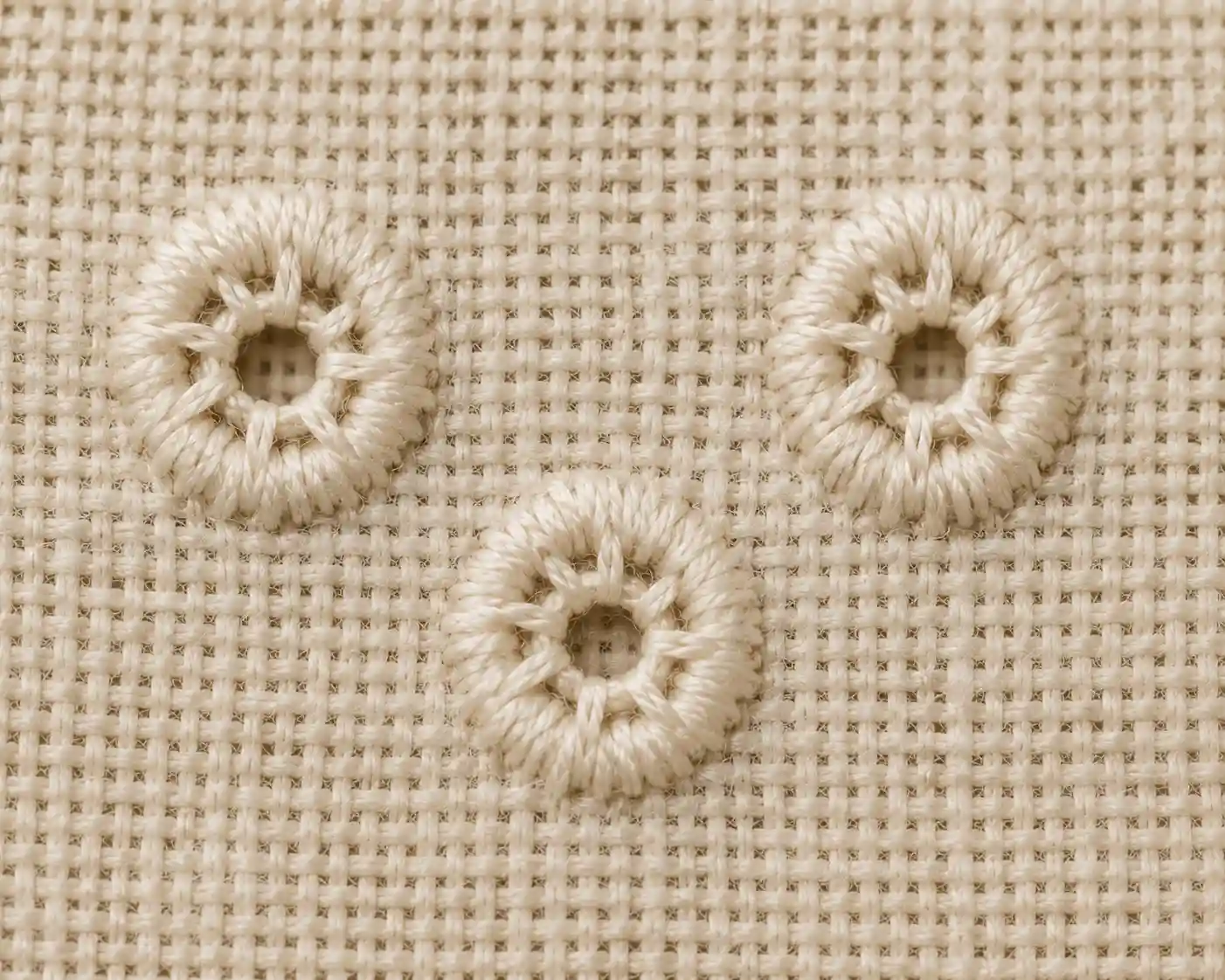
Algerian eye stitch is a star-shaped stitch worked from eight points around a square into a single shared center hole, pulled firm enough to open a small, visible eyelet at the middle. It's one of the classic filler stitches found scattered across historical band samplers, and I love it for exactly that reason - it adds texture between alphabet rows and motifs without competing with them for attention.
How to work it
Up at an outer point like 1, down into the shared center at 2 - repeat clockwise around all eight.
- Starting at any of the eight points around the square (the four corners and four edge-midpoints), bring the needle up.
- Insert the needle down into the exact center hole of the square.
- Bring the needle back up at the next point around the square.
- Insert down into the center again.
- Repeat around all eight points, always returning to the same center hole.
Every stitch shares that single center point, which is what creates the eyelet - as you work all eight spokes and pull each one firmly, the repeated piercing of the same hole gradually opens a small gap in the weave, giving the stitch its "eye."
Tips for a clean eyelet
- Work the spokes in a consistent order around the square (I go clockwise, always) rather than jumping around - it keeps tension even and the star symmetrical.
- Pull each stitch snug, not loose - the eyelet only forms with consistent firm tension on every spoke, not just the last one.
- A tapestry needle with a slightly larger eye than usual can help avoid fraying the center hole as you pass through it eight times - a trick I picked up after wearing through more than one center on a dense sampler.
Because each stitch shares a single point of stress on the fabric, Algerian eye works best on a sturdy, tightly woven fabric - loosely woven or very fine fabric can distort or tear at the center hole under repeated tension.
What it's used for
Filler and border details on traditional samplers - a single Algerian eye reads as a tiny star with a pinhole center, traditionally scattered as background texture between larger motifs.