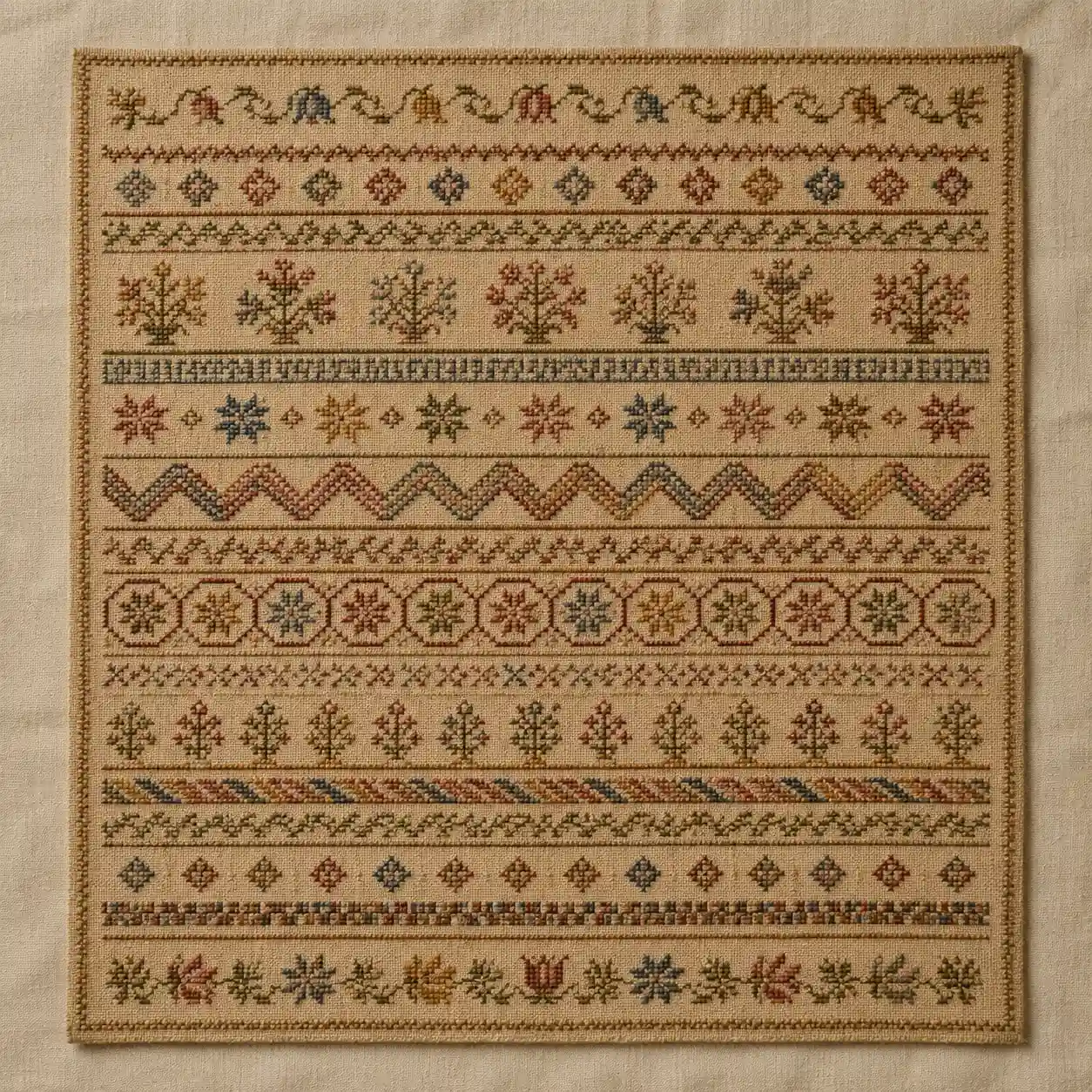
If you trace the sampler format back to its earliest surviving examples, you don't find alphabets and verses - you find bands. A band sampler is exactly what it sounds like: a long, narrow strip of linen, worked in horizontal rows (bands) stacked one below the next, each row usually a different stitch pattern, motif, or border design.
A notebook, not a composition
What strikes me most about band samplers is how little they care about being a unified, balanced picture - because that was never the point. Each band is really its own small entry, added as the stitcher learned or wanted to record a new pattern. Some bands repeat a single geometric border. Others show a small running sequence of motifs. The overall piece reads less like a designed artwork and more like a notebook, one page - one row - at a time.
This makes band samplers the most literal expression of what "sampler" meant originally: a sample of technique, kept for reference, not a finished decorative composition. See what is a cross-stitch sampler for how that original purpose shaped the format generally.
Why the strip shape
Practically, the tall, narrow strip shape had a real advantage: linen was expensive, and a long, thin scrap made efficient use of a narrow offcut or the edge of a bolt of cloth. It's also easy to add to - a stitcher could keep working new bands onto the bottom of a piece over months or years as she learned more, rather than committing to a fixed layout from the start, the way a later, more composed sampler would require.
From band to something more designed
Band samplers are generally considered the earliest widespread sampler format, dating from the 16th century onward in Europe. Over time, as the sampler as a format matured, the loose, additive band structure gradually gave way to more deliberately composed layouts - a centered alphabet, a symmetrical border, motifs arranged with intention rather than stacked as they were learned. That shift toward composition is really the birth of the alphabet sampler, the format most people picture and still stitch today.
I'd argue the band sampler is worth returning to even now, precisely because it's not trying to be a finished picture - it's a genuinely useful, low-pressure way to practice and record a handful of new stitches or border patterns without needing to plan a whole composition around them first.
Try it: a project idea
Stitch a "reference band" of your own - pick five stitches or motifs you want to remember and work them in a single narrow strip, exactly as the original band samplers did.