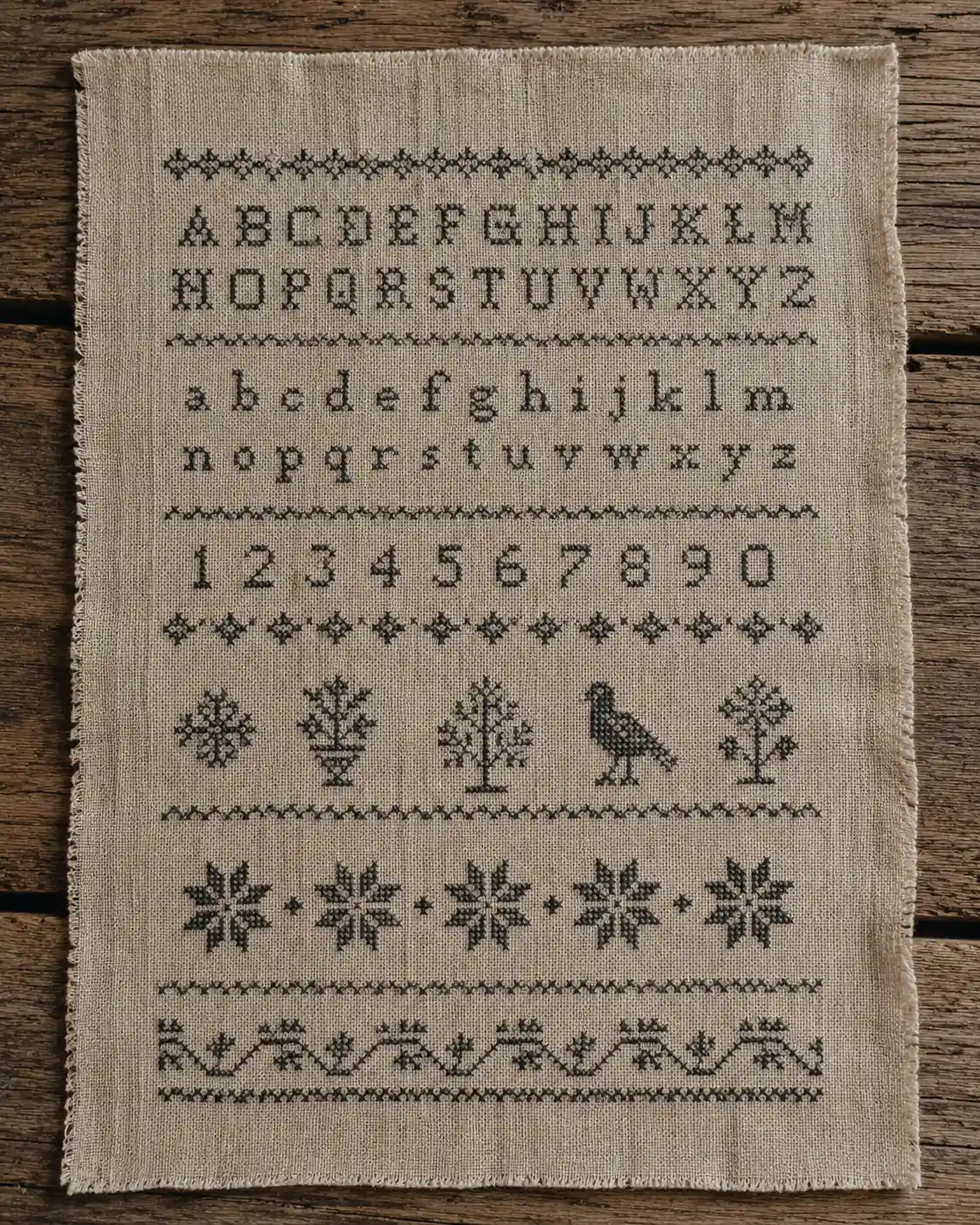
This is my favorite pivot point in the whole history, because it's the moment cross-stitch stops being just a technique and becomes an object - the sampler - that people still recognize and make five hundred years later, largely unchanged in purpose.
What a sampler actually was
A sampler is, literally, a sample: a length of linen worked with rows of stitches, alphabets, numerals, and small motifs, made to record and reference what its maker had learned. Before printed pattern books were common, a sampler functioned as a stitcher's personal reference library - a place to keep a border pattern, a favorite letterform, or a stitch variation so it could be copied into future work rather than relearned or forgotten.
The earliest surviving European samplers date to the 16th century, and by the 17th century the format had become widespread and fairly standardized: long, narrow bands of stitching worked top to bottom as the maker's skills and pattern collection grew, often over months or years. That "band" layout is exactly what the band sampler is named for, and it's the direct ancestor of the alphabet and verse samplers that followed.
Education, not just decoration
Samplers were also, unmistakably, a tool of girls' education. Learning to stitch a full alphabet, numerals, and a set of standard motifs was part of a young girl's domestic training - needlework literacy, essentially, taught alongside or instead of academic literacy depending on class and era. A finished sampler was proof of competence: patient, accurate, legible work, made under supervision, often signed and dated by its maker as a kind of certificate.
That signing-and-dating convention is worth sitting with, because it means samplers are one of the only surviving records where working-class and middle-class girls, largely absent from other historical documentation, left something behind with their own name and age on it. I think that's part of why genealogists and collectors care about samplers so much today - see family record samplers for where that thread leads.
From band to alphabet to verse
Over the 17th century, the format kept expanding. Alphabets moved from a minor element to the centerpiece of the alphabet sampler. Later additions included short verses, mottos, and religious texts, worked below the alphabet rows - a shift from purely technical reference toward something closer to personal or moral expression. It's a small but real turning point: the sampler starts saying something, not just demonstrating that its maker could stitch.
That expansion from technical reference to personal statement doesn't stop in the 17th century, either - trace it forward far enough and you land, eventually, at a very different kind of statement sampler in the subversive cross-stitch movement. But the next stop chronologically is the Victorian revival, where the sampler gets mass-produced, colorized, and turned into a full-blown craze.