If the sampler era is about individual skill, the Victorian era is about scale - and it's genuinely wild how fast it happened. Within a few decades, cross-stitch went from a household teaching tool to a mass-market hobby, and most of what makes modern cross-stitch feel "modern" - printed charts, standardized colors, a whole retail industry around patterns and floss - traces straight back to this period.
Berlin wool work
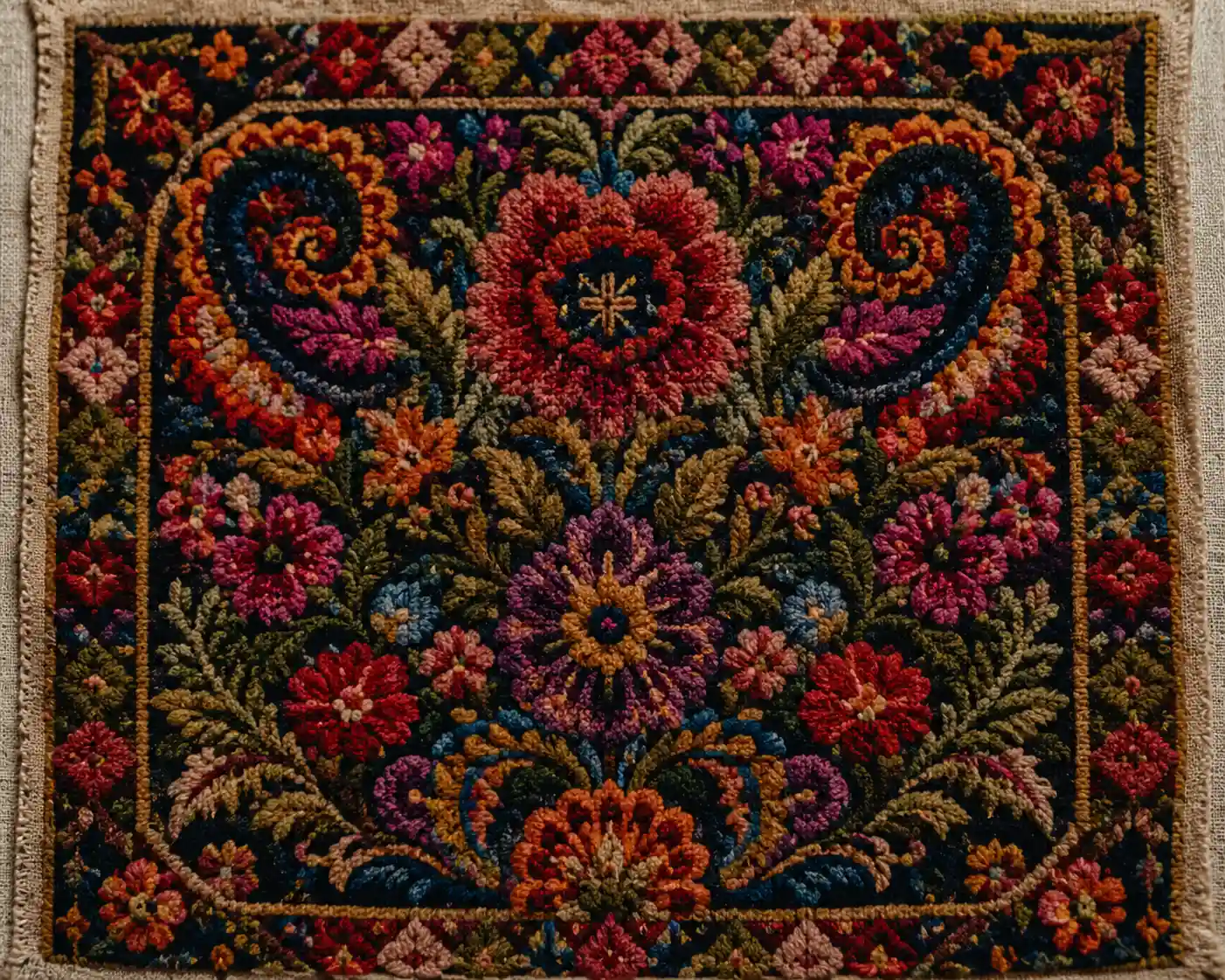
The centerpiece of this era is "Berlin wool work": bold, brightly colored cross-stitch worked in wool on canvas, wildly popular in wealthy parlours across Europe and, soon after, America. It got its name from Berlin, where the printed, hand-colored charts driving the craze were first published and exported. Unlike a sampler worked from memory or a borrowed piece of cloth, a Berlin wool work chart was a mass-produced object in its own right - a printed grid, filled in with color, meant to be followed square for square.
Two things made the style so visually distinctive: rich, saturated wool (rather than the finer silk or linen thread of earlier samplers) and a fondness for bold florals, exotic birds, and elaborate architectural borders, often produced for upholstery, footstools, and firescreens rather than framed pictures. It's ornate in a way earlier samplers rarely were - decoration for its own sake, not a record of skill.
Aniline dye added fuel later
Chemistry gave this boom a second wind, a few decades in - it didn't launch it. Berlin wool work's printed-chart industry was already well established by the 1830s, but the first synthetic aniline dye, mauveine, wasn't discovered until 1856, well after the craze had already taken hold. Once it arrived, though, it made intensely saturated, consistent color available cheaply for the first time - a sharp contrast to the more limited, natural-dye palette earlier stitchers worked with - and bright, uniform wool colors suited the bold Berlin wool work aesthetic perfectly, extending and intensifying a craze the printed charts had already ignited.
Printed charts and the birth of the pattern industry
This is the piece I think gets underrated: before this era, patterns spread person to person, sampler to sampler, largely by direct copying. The Victorian era industrialized that process. Printed, gridded, hand-colored charts could be produced at scale and distributed by mail across Europe, giving rise to a genuine commercial pattern industry - publishers, retailers, and eventually branded thread companies selling directly to home stitchers.
That shift, from patterns as inherited knowledge to patterns as a purchasable product, is the direct ancestor of the kit-and-chart format the hobby still uses today. I go into that publishing and format history in more depth on how patterns evolved from kits to counted charts - it's a small niche topic, but it's the missing link between a hand-copied 17th-century sampler and the printed chart sitting on your table right now.
The high point before the fall
By the mid-to-late 19th century, Berlin wool work and its cross-stitch descendants were arguably at the height of their cultural relevance - a genuine domestic craze, not a niche hobby. That popularity wouldn't last. The 20th-century decline that followed is a fairly dramatic reversal, and it's worth understanding this Victorian peak to appreciate just how far the craft fell before it found its way back.