Of everything in this history, the 20th century is the chapter I find most quietly dramatic, precisely because so little seems to happen in it. A skill that had been taught to nearly every girl in Europe and America for three centuries essentially stopped being a default part of growing up - and it happened within a couple of generations.
Why hand needlework declined
There's no single cause, but a few forces line up closely with the timing. Industrialization made machine-made textiles and clothing cheap and widely available, quietly removing the practical need to hand-mark, mend, or embellish household linen that had justified needlework instruction for centuries. Two world wars and the economic disruption between them pulled women into paid labor and away from the domestic-education curriculum that had included needlework as standard. And changing ideas about girls' education, later in the century, increasingly deprioritized needlework in favor of academic subjects.
The result wasn't extinction - cross-stitch and embroidery never fully vanished - but it did stop being a skill passed down as a matter of course in most households. By the mid-20th century, it had shifted from "something every girl learns" to "something some people do as a hobby," which is a real change in cultural status, even if the stitch itself didn't change at all.
A quiet return, mid-century
Needlework didn't disappear so much as go dormant, and it came back gradually rather than in one dramatic revival. Postwar decades saw renewed interest in home crafts generally, and cross-stitch kits - pre-printed fabric, pre-sorted floss, a clear chart, everything a beginner needed in one box - became a genuinely accessible entry point, lowering the skill floor in a way earlier generations, taught needlework from childhood, never needed. That kit format owes a direct debt to the printed-chart industry the Victorian era built; see how patterns evolved from kits to counted charts for the fuller publishing story.
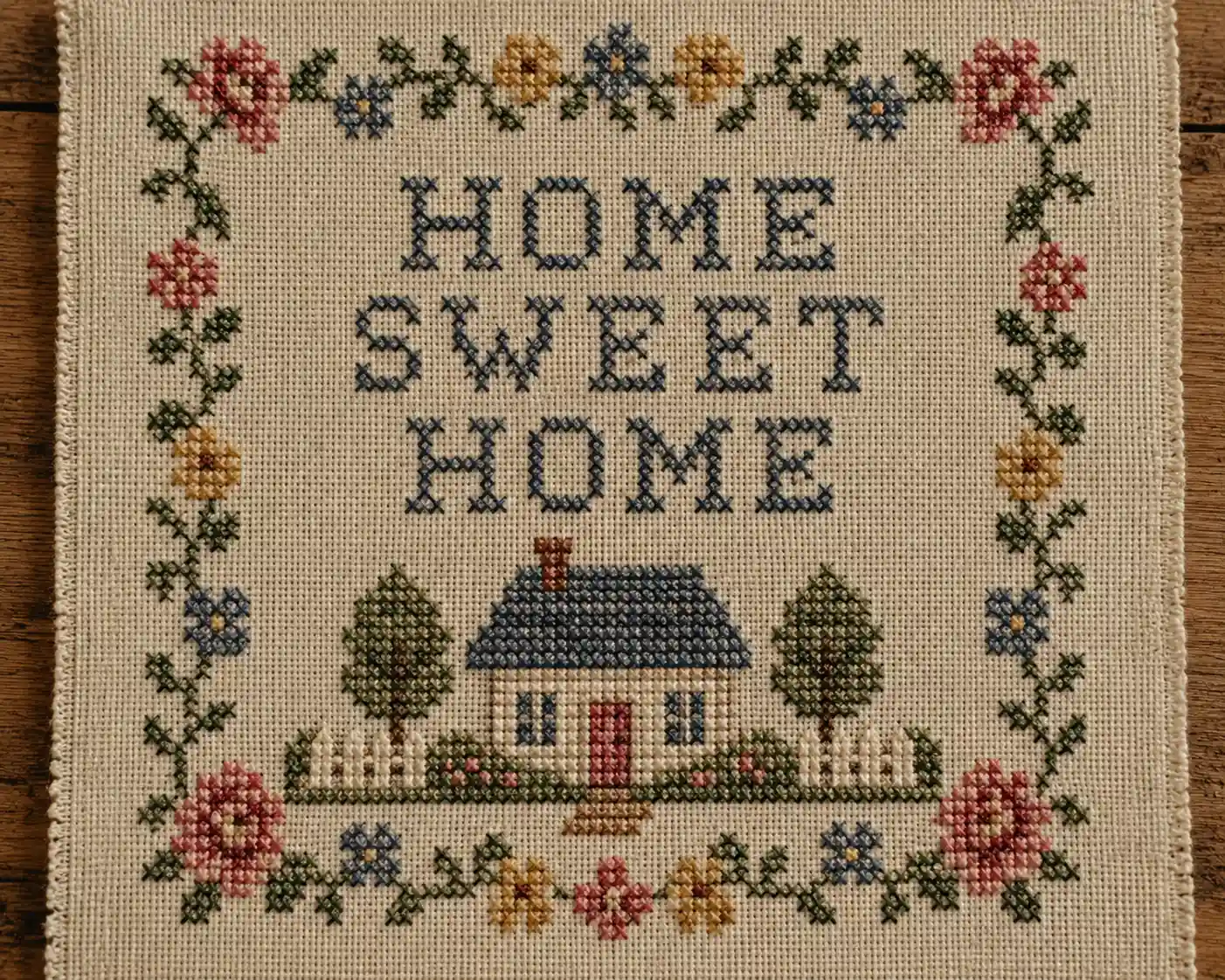
Through the later 20th century, cross-stitch settled into a fairly comfortable, somewhat nostalgic hobby-craft identity - florals, cottages, "Home Sweet Home" mottos, the kind of design you'd expect from a craft associated with grandmothers and church craft fairs. Which is exactly the reputation that made what happened next so pointed.
Setting up the turn
By the time the century was ending, cross-stitch had a very settled, very wholesome public image: prim, decorative, slightly old-fashioned. That reputation is precisely the raw material the next generation of stitchers needed. Deliberately taking the most polite, grandmotherly craft format imaginable and using it to stitch profanity, punk slogans, and political statements only works as a joke - and as a statement - because everyone already knows what cross-stitch is "supposed" to look like.
That's where the story goes next: what subversive cross-stitch is and where it came from, the chapter that brings this history right up to the present.