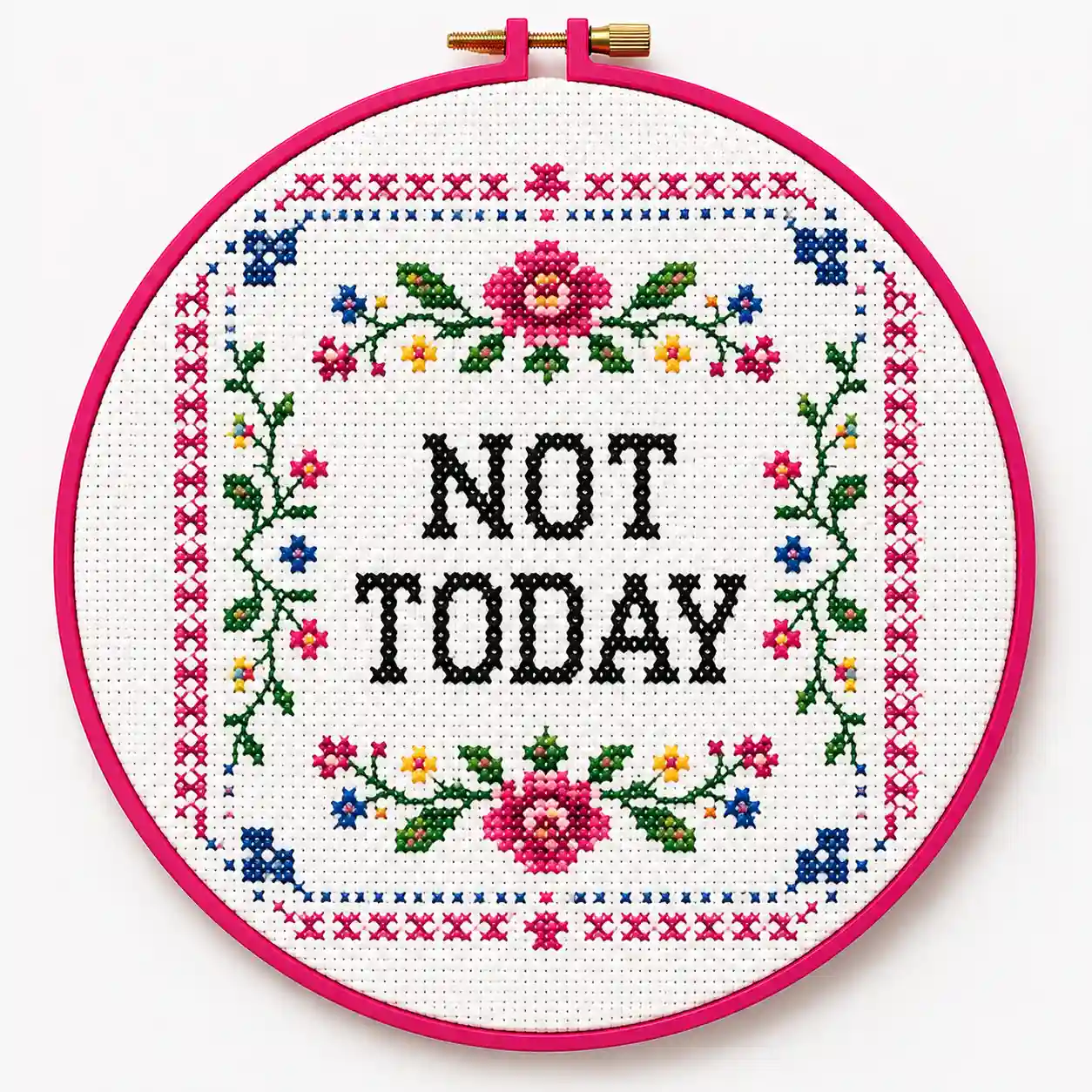
Here's the angle of this whole site I care about most, so it gets the cornerstone spot in this section: "subversive cross-stitch" isn't a rejection of the traditional sampler - it's a very deliberate use of it. Take the exact format generations of girls used to stitch "Bless This House" or a pious verse, keep every visual convention intact, and swap in something the format was never supposed to say. The joke, and the point, depends entirely on the format being recognizable.
Why the format matters as much as the words
If you stitched a swear word in a font on a t-shirt, it's just profanity. Stitch the same word in a tidy serif alphabet, centered inside a floral border, signed and dated the way a Victorian verse sampler would be - and suddenly it's doing something more specific: borrowing the visual authority of "proper," "wholesome" needlework and using it against expectation. The craft's own history supplies the contrast. Without the sampler's centuries of prim reputation behind it, there's no subversion to speak of - just decoration.
That's why I'd argue subversive cross-stitch is best understood as a continuation of the sampler tradition, not a break from it. Verse samplers always used the format to say something with weight - a moral, a memorial, a family record. Subversive pieces are doing exactly the same structural job with very different content.
What counts as "subversive" here
This isn't one single style so much as a shared attitude expressed across several: blunt profanity and dark humor (see snarky and sweary), sharp political and social commentary (see feminist and political), and a general willingness to use "nice" craft aesthetics for anything but nice, safe content. Pop culture and fandom pieces, punk and zine-influenced stitching, even some minimalist and photo-realistic work can carry a subversive edge depending on subject matter - the throughline is less about a specific look and more about intentionally undercutting expectation.
Why now, and why cross-stitch specifically
The timing isn't a coincidence. By the late 20th century, cross-stitch had settled into a very safe, nostalgic, slightly old-fashioned reputation - exactly the kind of stable, widely recognized visual shorthand a subversive joke needs to land. You can't subvert a format nobody has expectations of. Cross-stitch, uniquely among crafts, came pre-loaded with several centuries of prim, wholesome, grandmotherly associations, which is precisely what made it such fertile ground once a new generation decided to mess with it. For the fuller story of how that generational shift actually happened, where the subversive movement came from picks up right where this page leaves off.
Try it: a project idea
Take a phrase you'd never expect to see stitched - something blunt, funny, or just very you - and set it in a classic sampler layout: centered text, a tidy border, your name and the date underneath. The contrast is the whole point.