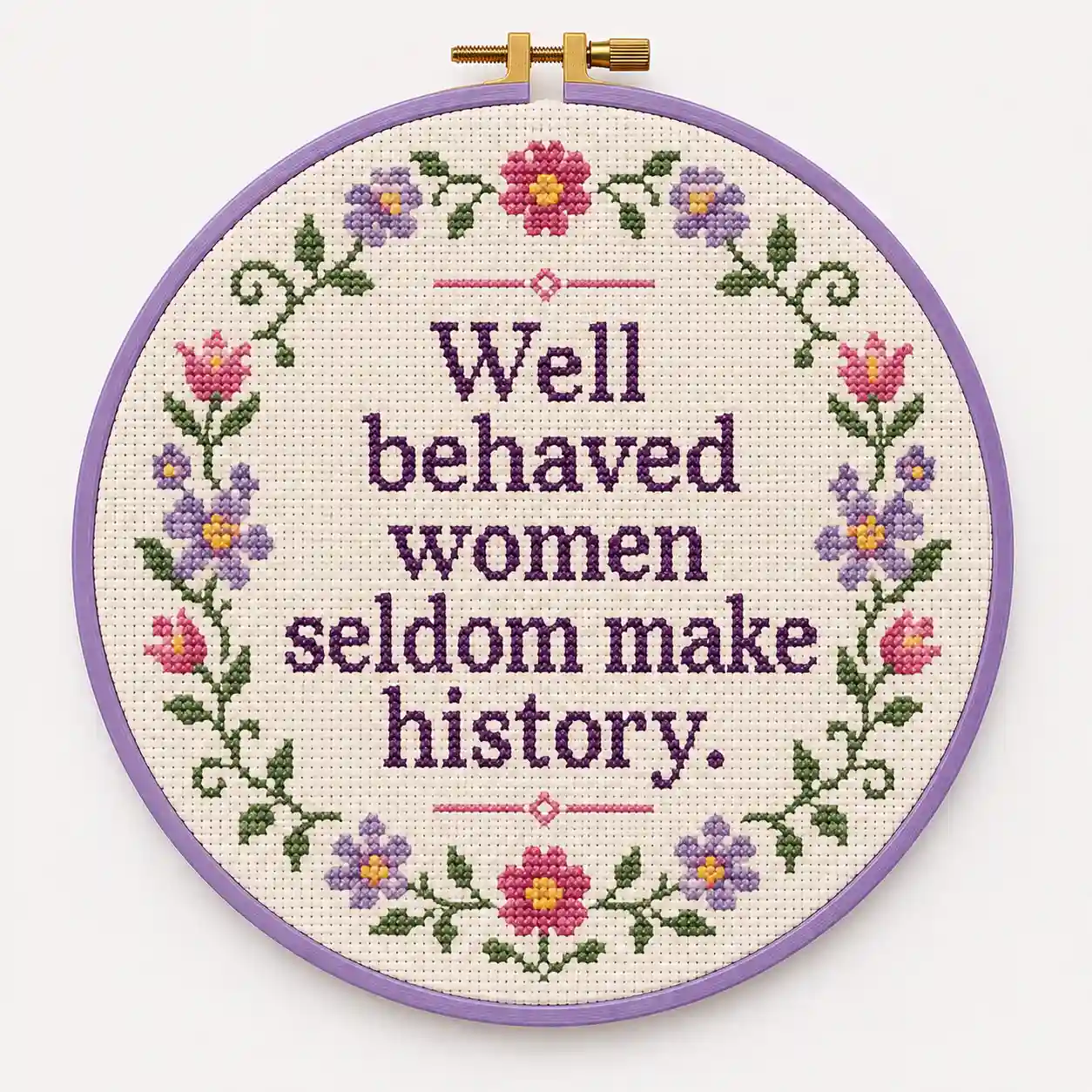
Of everything in this section, this is the style where the craft's own history is doing the most direct rhetorical work. Feminist and political cross-stitch takes a technique that was, for centuries, specifically imposed on girls as domestic and moral training - see the rise of the sampler for how literally that's true - and uses that exact same technique to say something about gender, power, labor, or politics. The history isn't incidental to this style; it's frequently the point.
"Women's work," reclaimed on purpose
A huge amount of this style's power comes from a very deliberate irony: needlework was, for generations, treated as a lesser, purely domestic skill - proof a girl could be patient, obedient, and quiet, not a vehicle for her own opinions (recall those often fairly heavy-handed moral verse samplers girls were assigned to stitch, rather than choosing themselves). Using that same "quiet domestic craft" to make an explicitly feminist or political statement inverts the assumption directly: the same patient, careful labor once used to demonstrate obedience is repurposed to state an opinion loudly and permanently.
What this style actually covers
This isn't one single message - it spans reproductive rights and bodily autonomy, labor and pay equity, body image, and broader social and political commentary well beyond gender specifically. What ties the style together isn't subject matter so much as a shared willingness to use the "nice," non-threatening craft format to say something pointed, sometimes confrontational, rather than purely decorative.
Sharing space with punk and DIY sensibilities
Feminist and political stitching overlaps substantially with punk, DIY, and zine-influenced work - both draw on a shared history of self-published, hand-made protest media, from actual protest banners to zines to patches. Some feminist political pieces lean into that rough, urgent, hand-cut aesthetic directly; others use immaculate, traditional-style technique specifically because the contrast between "prim craft" and "pointed message" is itself the statement, the same mechanism subversive cross-stitch runs on generally.
Why permanence matters here
I think what separates a stitched political statement from a printed sign or a social media post is durability: cross-stitch takes real time and care to make, and it survives - often literally for generations, the way historical samplers have. Choosing to spend hours of hand labor making a political statement permanent, rather than posting it and moving on, is a genuinely different kind of commitment than most political expression today, and it's worth sitting with that when choosing what to stitch and why.
Try it: a project idea
Stitch a phrase or statement you actually believe, in your own words, rather than a widely circulated slogan - the format carries the most weight when the words are specific and genuinely yours.