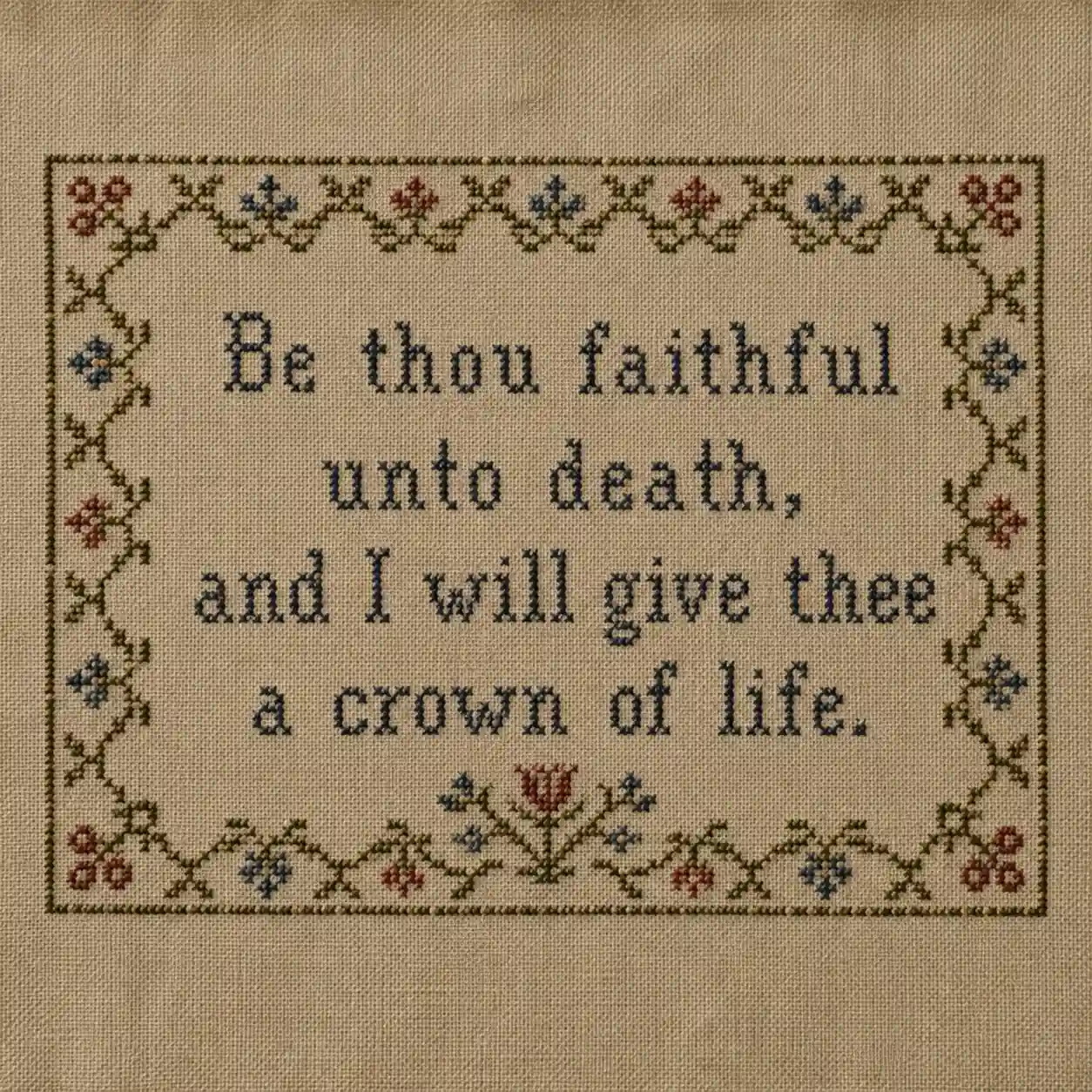
This is the sampler style where the object stops being purely functional and starts being expressive - and I think it's an underrated turning point in the whole history. An alphabet sampler proves you can stitch letters. A verse sampler uses those same letters to actually say something: a moral lesson, a religious text, a piece of advice, or a short poem, worked in full below the more familiar alphabet and border.
From reference to statement
Earlier sampler formats - band samplers, and early alphabet samplers - are essentially reference documents: proof of skill, a catalogue of patterns. A verse sampler adds something those formats never needed: content with actual meaning, chosen (or assigned) because of what it says, not just how it looks. Stitching an alphabet demonstrates technique. Stitching a full verse, correctly spelled and evenly spaced across many rows, demonstrates something closer to literacy and patience combined.
What the verses actually said
Common verse sources included religious texts and hymn excerpts, moral maxims about diligence, obedience, or virtue, and short devotional poems, often selected by a teacher or governess rather than freely chosen by the girl stitching them. It's worth being honest about the tone here: many surviving verses read, to modern eyes, as fairly heavy-handed moral instruction aimed squarely at girls - a stitched reminder to be industrious, humble, and good. One branch of Quaker samplers - the plainer "extract" style, distinct from the geometric "medallion" samplers more often pictured - took this even further, centering plain, explicitly religious verse over decorative motifs almost entirely.
The long echo of this format
I find it genuinely striking how directly this format anticipates something that happens centuries later. A verse sampler is, structurally, identical to a lot of what's stitched today: a chosen piece of text, given weight and permanence by being carefully worked in thread rather than just spoken or written. The subversive cross-stitch movement - sweary samplers, punk slogans, blunt modern statements - is doing exactly the same thing a Victorian verse sampler did, just swapping out "Be Diligent In All Things" for something with considerably more bite. Once you notice that structural echo, a lot of modern "ironic" cross-stitch reads less like a joke about the format and more like a genuinely faithful continuation of it.
A note on mourning verses
One especially distinct branch of this tradition, verses written specifically to memorialize the dead, became common and stylistically consistent enough to deserve its own page - see mourning samplers for that particular, unusually poignant corner of the format.
Try it: a project idea
Stitch a short quote or line that actually means something to you, rather than a stock historical verse - a modern verse sampler in the same spirit as the originals, just with your own words in it.