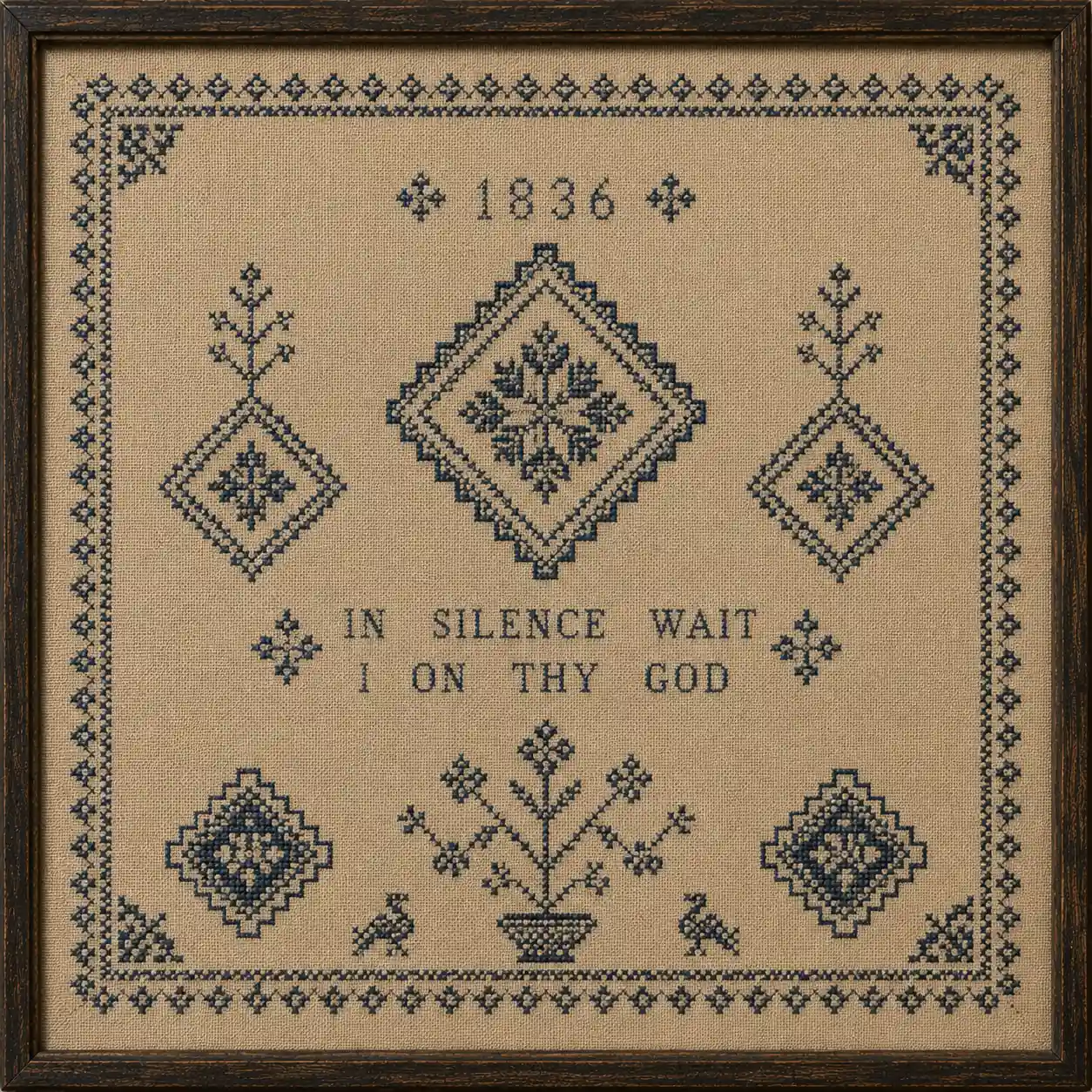
Of all the historical sampler styles, this is the one I most often see modern stitchers rediscover with genuine surprise - because it doesn't look "antique" the way most sampler styles do. Quaker samplers, made in Quaker schools in Britain and America roughly from the 18th into the 19th century, are geometric, restrained, and quietly graphic in a way that reads as strikingly contemporary.
Restraint as a value, not just an aesthetic
Quaker religious philosophy places strong emphasis on plainness and simplicity, actively discouraging ornament and decoration for its own sake, and that value system shows up directly in the needlework produced in Quaker schools. Where other sampler traditions leaned into florals, figures, and increasingly elaborate borders, Quaker samplers favor geometric motifs - diamonds, stepped pyramids, stylized trees and baskets reduced to simple angular shapes - and a noticeably more limited color palette, often worked in just one or two thread colors rather than a full rainbow.
This isn't a lack of skill or ambition. It's a deliberate aesthetic choice, growing directly out of a belief system that treated visual restraint as a virtue. Quaker schools actually produced two distinct expressions of that same restraint: the geometric "medallion" style described above, and a plainer "extract" style that dropped decorative motifs almost entirely in favor of plain religious verse - see verse and motto samplers for that text-forward branch of the same tradition.
A distinct school tradition
Quaker samplers were typically produced in specific, identifiable Quaker schools, and needlework historians can often trace a given sampler to a particular school based on its characteristic motifs, layout conventions, and even specific alphabet styles used there - samplers as a kind of institutional fingerprint, not just an individual girl's personal work. That level of stylistic consistency, tied to specific schools rather than a broad regional trend, is fairly unusual among historical sampler traditions and makes Quaker samplers a genuinely rich subject for collectors and needlework historians.
Why it feels so modern
I think the reason Quaker samplers read as strikingly modern to contemporary eyes is straightforward: restrained color, geometric abstraction, and generous negative space are exactly the visual values the minimalist and geometric style favors today, arrived at completely independently, a couple hundred years earlier, for religious rather than aesthetic reasons. It's a genuinely good reminder that "modern minimalism" in cross-stitch isn't actually new - it has a real historical precedent, it just got there by a very different road.
Try it: a project idea
Design a small sampler using only geometric motifs - no florals, no figures - restricted to one or two thread colors, in the same spirit of deliberate restraint Quaker samplers are known for.