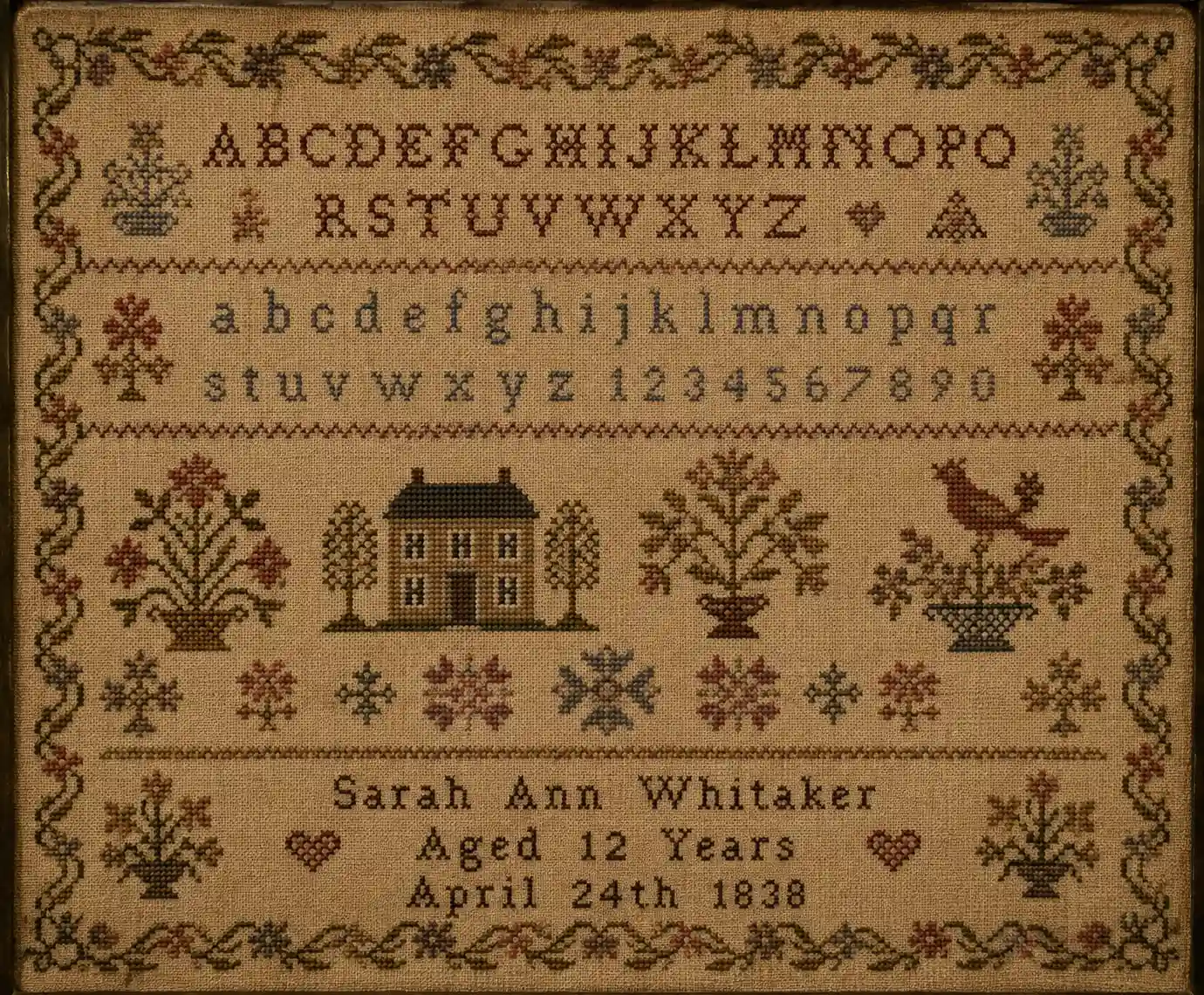
Ask someone who doesn't stitch to picture "cross-stitch," and there's a good chance what they're picturing is a sampler: a piece of linen with an alphabet, some small motifs, a border, and a name and date stitched somewhere near the bottom. That association isn't an accident - the sampler is the format the entire hobby grew up around, and it's worth understanding on its own terms before diving into its many sub-styles.
A sample, not a picture
The word "sampler" means exactly what it sounds like: a sample. Originally, that's precisely what it was - a working reference of stitches, alphabets, and motifs a stitcher had learned and wanted to keep for later, made at a time when patterns weren't printed or widely available (see origins in ancient and medieval needlework for what came before this format existed). A sampler wasn't made to be admired so much as consulted, the way you'd keep a recipe card rather than frame it.
That practical original purpose is easy to lose sight of now that samplers are usually stitched, framed, and displayed as finished decorative pieces. But it explains the format's defining features: an alphabet (so letterforms are on hand for future labeling or monogramming), a scattering of small motifs (a reference library of designs), and often a border (a record of a border pattern worth reusing).
The core ingredients
Most traditional samplers, across their many regional and period variations, combine some mix of:
- An alphabet, often in more than one typeface or size
- Numerals, usually 0–9 or 1–20
- Small motifs - flowers, birds, hearts, houses, geometric fillers
- A border, framing the whole piece
- The maker's name and the date, and sometimes their age
Not every sampler includes all of these, and the balance between them shifted a great deal by era and purpose - see band samplers for the earliest, most reference-heavy layout, and alphabet samplers for the format most people learn first today.
Why the maker's name and date matter so much
I think this detail is the most quietly moving part of sampler history: a huge number of surviving samplers are signed and dated by their makers, often girls as young as seven or eight. In eras where most working- and middle-class women left few personal records behind, a signed, dated sampler is sometimes the only surviving trace of a specific girl's existence - her name, her age, and proof of the patient, careful work she was capable of. That's part of why samplers matter so much to genealogists today; see family record samplers for where that interest becomes the sampler's explicit purpose.
One format, many later styles
Everything else in this section - verse samplers, mourning samplers, Quaker samplers, the whole ornate Berlin woolwork tradition - is a variation on this same core object, shaped by a particular era, community, or purpose. Once you can recognize the sampler's basic ingredients, the differences between those styles become a lot easier to read, and a lot more interesting than "old-fashioned cross-stitch" as a single, undifferentiated category.
Try it: a project idea
If you've never stitched a sampler, start small - a single alphabet row plus your name and the year is a genuinely faithful mini-version of the original format, not a watered-down one.