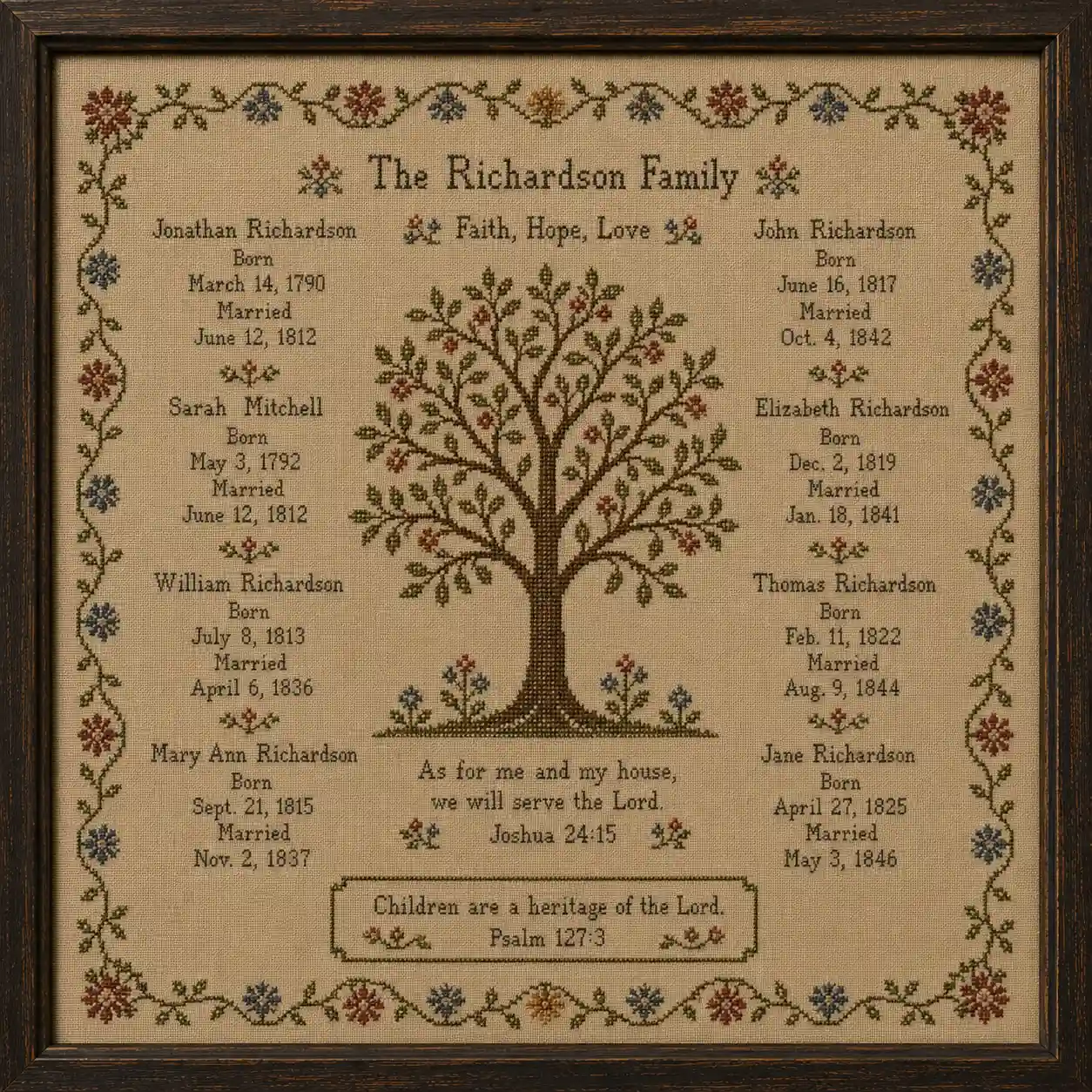
Most sampler styles record a skill or a moment. Family record samplers record an entire family - names, birth dates, sometimes marriages and deaths, arranged around a central tree, house, or decorative motif - and they're the sampler genre I think has aged the best, in the sense that people are still stitching brand-new versions of it today, largely unchanged in purpose.
What a family record sampler actually shows
The core content is genealogical: a family tree structure, or a simple list format, recording parents and children with their birth years, laid out around (or instead of) the more usual alphabet-and-motif composition. Many examples use a central tree, its branches labeled with family members' names, a visual metaphor that's stayed durable enough to still be the default design choice for this genre in modern kits and charts.
This makes family record samplers a genuine hybrid: part sampler in form (worked in cross-stitch, framed by a border, dated and often signed by the stitcher), part practical genealogical document, made at a time when official birth and family records were far less consistently kept, especially for ordinary families outside wealthier or more literate households.
Why genealogists actually care about these
I think this is the most concretely useful historical role any sampler style plays: a well-preserved family record sampler can be a primary source. For families without reliable parish or civil records - common the further back or the less prosperous a family was - a stitched, dated family tree made by a family member is sometimes the most complete surviving account of who was born when, and in what order. That's a genuinely different kind of value than the aesthetic or symbolic weight most sampler styles carry, and it's part of why familial and genealogical societies actively collect and study these pieces. Mourning samplers sit right alongside this genre for similar reasons - both use the sampler format to preserve exactly the kind of personal, familial detail official records often missed.
A living tradition, not just a historical one
Unlike most of the styles in this section, family record samplers never really stopped being made - modern chart designers still sell family-tree sampler patterns today, largely following the same central-tree, name-and-date layout established well over a century ago. If you want to try the format yourself, it's one of the most personally meaningful traditional-style projects on this whole site: a piece that documents your own family the exact way this genre always has.
Try it: a project idea
Stitch a small family record for your own household - parents, children, and birth years, arranged around a simple central motif - using a modern family-tree sampler chart or laying out your own.