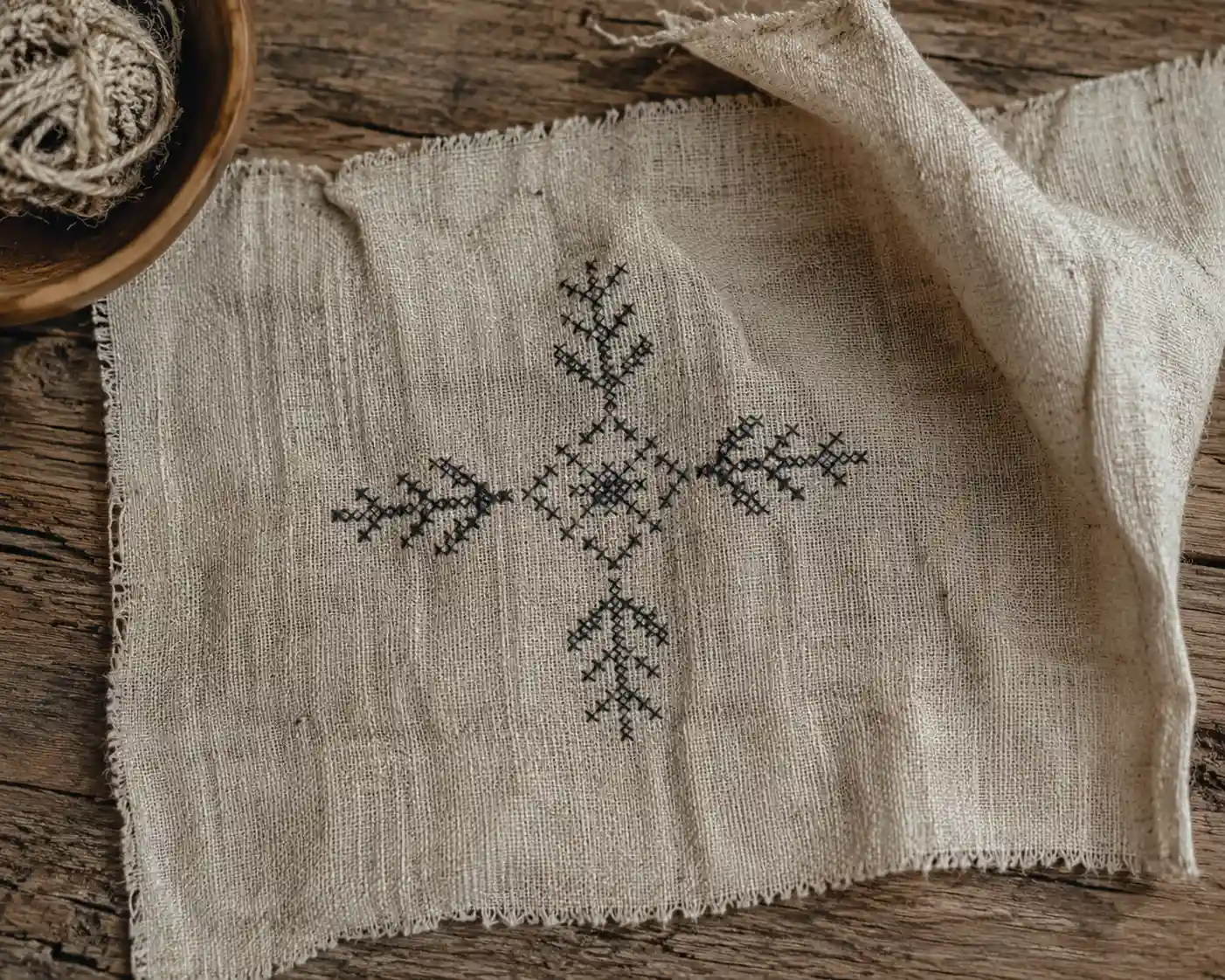
I find it genuinely reassuring that cross-stitch doesn't have a single inventor or a single country of origin. It's one of those techniques - like the plain weave underneath it - that people seem to arrive at independently wherever the conditions are right: woven cloth with a countable grid, a needle, thread, and time. That's the real starting point of this history, and it's centuries earlier and considerably more scattered than the sampler story most people know.
The stitch before the name
Surviving fragments of X-shaped stitching turn up in textile finds across a striking range of places and periods - Egyptian Coptic textiles from the first millennium, Chinese and Central Asian pieces, and rural European work, among others. None of these were called "cross-stitch" at the time. The stitch was simply a practical way to secure, mark, or decorate cloth using the weave itself as a guide, long before anyone treated it as a named, catalogued technique.
What ties these finds together isn't shared influence so much as shared logic: worked over the regular over-under structure of woven fabric, an X-shaped stitch is self-aligning. You don't need to draw a design freehand or trace a template - you just count threads. That's an enormous advantage anywhere embroidery was done by hand, by candlelight, without printed patterns to copy from.
Why "countable" mattered so much
It's worth pausing on this, because it explains almost everything that happens later in cross-stitch history. Freehand embroidery - satin stitch, crewelwork, needlepainting - demands a drawn or transferred design and a fair amount of drawing skill. Counted-thread work like cross-stitch needs none of that. A stitcher could reproduce a motif from memory, from another piece of cloth held alongside her work, or later, from a printed chart, purely by counting threads and repeating a stitch.
That portability of technique - motifs that could travel stitch-count by stitch-count, needing no artistic reproduction skill - is precisely what let embroidery become a shared visual language passed between women, regions, and generations. It's also what made the sampler possible as a teaching format a few centuries later: you can't teach freehand painting from a chart, but you absolutely can teach counted stitches that way.
Medieval Europe: utility first, decoration second
By the medieval period in Europe, counted cross-stitch and related counted techniques appear mostly in a utilitarian role: marking household linens, reinforcing seams, and adding modest decorative borders to garments and church textiles. This wasn't yet the parlour art it would become - it was closer to a practical skill, taught early and used constantly, the needlework equivalent of knowing how to mend a hem.
That utilitarian starting point matters because it's the thread (so to speak) that runs all the way through this site's history section. Cross-stitch keeps returning to practical, personal uses - marking, recording, teaching - even as its decorative ambitions grow. The next major chapter, the rise of the sampler, is where that teaching function gets formalized into the object most people now associate with the craft.