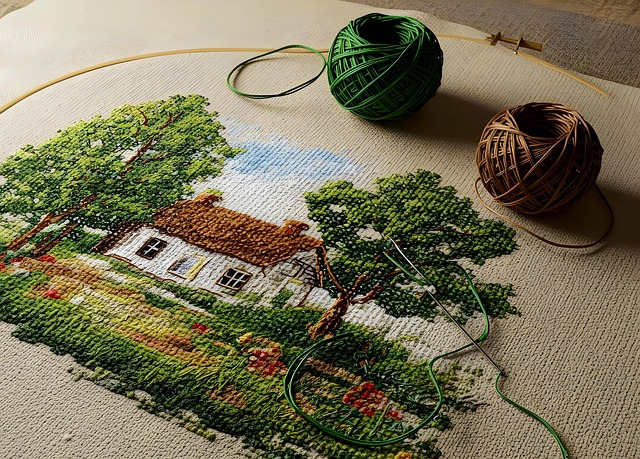
Cross-stitch is one of the oldest counted-thread techniques still in everyday use, and the more of its history I read, the more it feels like a story about purpose shifting over and over: from marking linen, to teaching girls their letters, to filling Victorian parlours with wool flowers, to nearly disappearing altogether, to becoming - improbably - one of the internet's favorite crafts for stitching swear words onto throw pillows. I find I understand my own stitching a lot better with this whole arc in view, which is why I wanted to map it out before writing anything else on this site.
This page is that map. Each era below links out to its own page with the full detail, in case one of them grabs you the way it grabbed me.
Before it had a name
The X-shaped stitch at the center of cross-stitch is ancient and turns up independently in textile traditions across the world - wherever people had woven cloth, a needle, and thread to spare. Surviving fragments from ancient and medieval needlework show the stitch used long before anyone called it "cross-stitch," often on garments and household linens rather than as decorative art in its own right.
What made it durable as a technique, long before it was fashionable, is that it's countable: worked over the regular grid of a woven fabric, it doesn't require drawing or freehand skill, just the ability to count threads. That's a property I still think about every time I sit down with a chart - it's the through-line of the entire history that follows.
The sampler era (16th–17th century)
By the 1500s in Europe, that countable quality turned the stitch into a teaching tool. A sampler - literally a "sample" of stitches - let a girl record and reference the patterns, alphabets, and motifs she'd learned, at a time when needlework patterns weren't printed or widely available. See the rise of the sampler for how band samplers, alphabet rows, and verse pieces became a rite of passage in girls' education for the next 300 years.
Samplers from this period were practical documents as much as decorative ones. A well-kept sampler was a reference library in thread: an inventory of stitches, letterforms, and border patterns a stitcher could return to for other projects - and, later, a proof of household linen ownership through name-marking. I find that grounding a little humbling, honestly, every time I pick up a hoop for fun rather than necessity.
The Victorian explosion (19th century)
The 19th century changed cross-stitch twice over. First, the invention of printed, gridded charts (rather than patterns worked from a stitched model or memory) meant complex designs could be mass-produced and mailed across Europe. Second, "Berlin wool work" - bold, brightly colored cross-stitch worked in wool on canvas - became a genuine craze in wealthy parlours, driven first by a booming pattern-publishing industry and then, a few decades later, by the arrival of cheap aniline dyes that intensified it further.
The Victorian revival is really the birth of cross-stitch as mass hobby craft rather than household necessity or needlework education - the direct ancestor of the kit-and-chart format I still buy into today.
Decline, and a slow return
Hand needlework fell out of fashion through much of the 20th century, squeezed out by industrialization, changing domestic roles, and, eventually, competition from other crafts. It didn't disappear, but it stopped being a default skill passed down in most households - which is roughly why I had to learn it as an adult from books and strangers on the internet, rather than from anyone in my own family.
Its return - first as a nostalgic hobby, later as something stranger and more interesting - sets up my favorite turn in this story.
The subversive turn (late 20th century–today)
Rooted in 1990s craft-reclaiming culture, taking recognizable shape as its own named movement in the 2000s, and then accelerating with the internet, a new generation of stitchers began deliberately undercutting the sampler's prim, decorative reputation: cross-stitching swear words, punk slogans, pop-culture references, and political statements into the exact format their great-grandmothers used for "Bless This House." It's a direct, knowing inversion of the craft's history rather than a break from it - which is exactly why it's such a distinctive angle for the medium today, and exactly the angle that got me hooked on this hobby in the first place.
Read the full story on what subversive cross-stitch is and where it came from, or jump into the technique pages if you're here to actually start stitching.