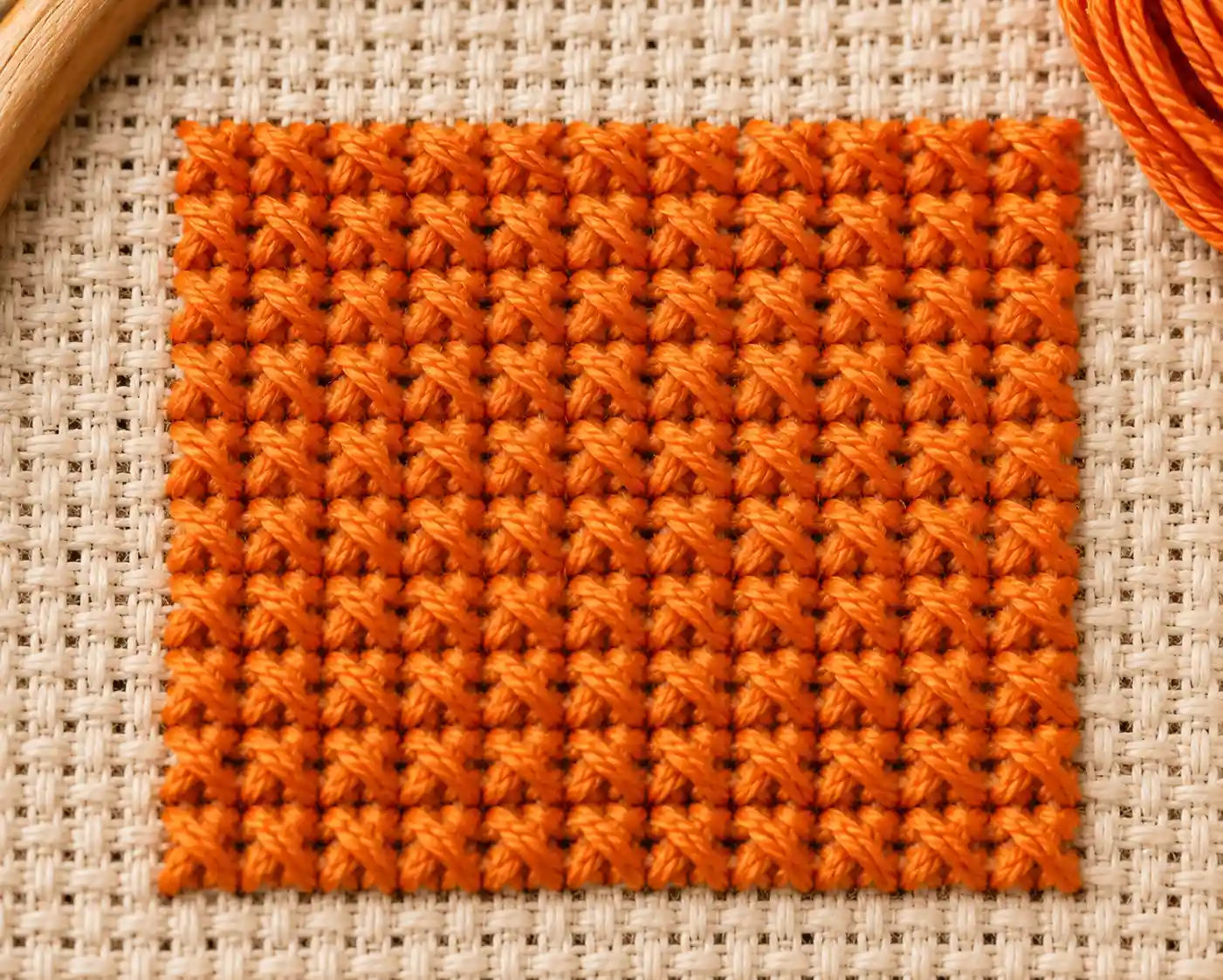
The full cross stitch is two diagonal stitches crossed over each other to form an "X," worked over one block of Aida cloth or one intersection of evenweave threads. If I could only teach you one stitch, it'd be this one - it's the stitch that gives the whole technique its name, and it's what I still spend most of my own stitching time doing, pattern after pattern.
How to work it
Up at 1, down at 2 - up at 3, down at 4. One block, one X.
- Bring the needle up through the fabric at the bottom-right corner of the square you're stitching.
- Cross diagonally and insert the needle down through the top-left corner.
- Bring the needle back up through the bottom-left corner.
- Cross diagonally again and insert the needle down through the top-right corner, completing the X.
That's a single, complete cross stitch. There are two common ways to work a whole row of them:
- One at a time - complete each X fully (steps 1–4) before moving to the next square. Simpler to learn, but slightly slower and easier to lose track of stitch direction over a large area.
- Row method (my go-to once you're comfortable) - work a full row of half-stitches left to right (steps 1–2 repeated across the row), then come back right to left completing the second diagonal of each stitch. This is faster and makes it much easier to keep every top stitch running in the same direction, which is the thing I actually care about.
Keeping it neat
The single most common beginner mistake isn't a wrong stitch - it's inconsistent direction, and I still catch myself doing it if I'm stitching half-asleep. Every top diagonal in a finished piece should lie the same way (I default to bottom-left to top-right, but pick one and stick with it). Mixed directions catch the light differently and are very noticeable from a normal viewing distance, especially in solid-color areas. See stitching direction and consistency for why this happens and how the row method prevents it.
Keep your tension even - I pull the thread snug enough that the stitch lies flat against the fabric, but never so tight that it puckers the weave. Aida cloth is forgiving here; evenweave and linen are less so (see working over two threads if you're moving from Aida to a finer fabric).
What it's used for
The base stitch for nearly every cross-stitch design - full coverage areas, solid blocks of color, and the vast majority of any printed or charted pattern.