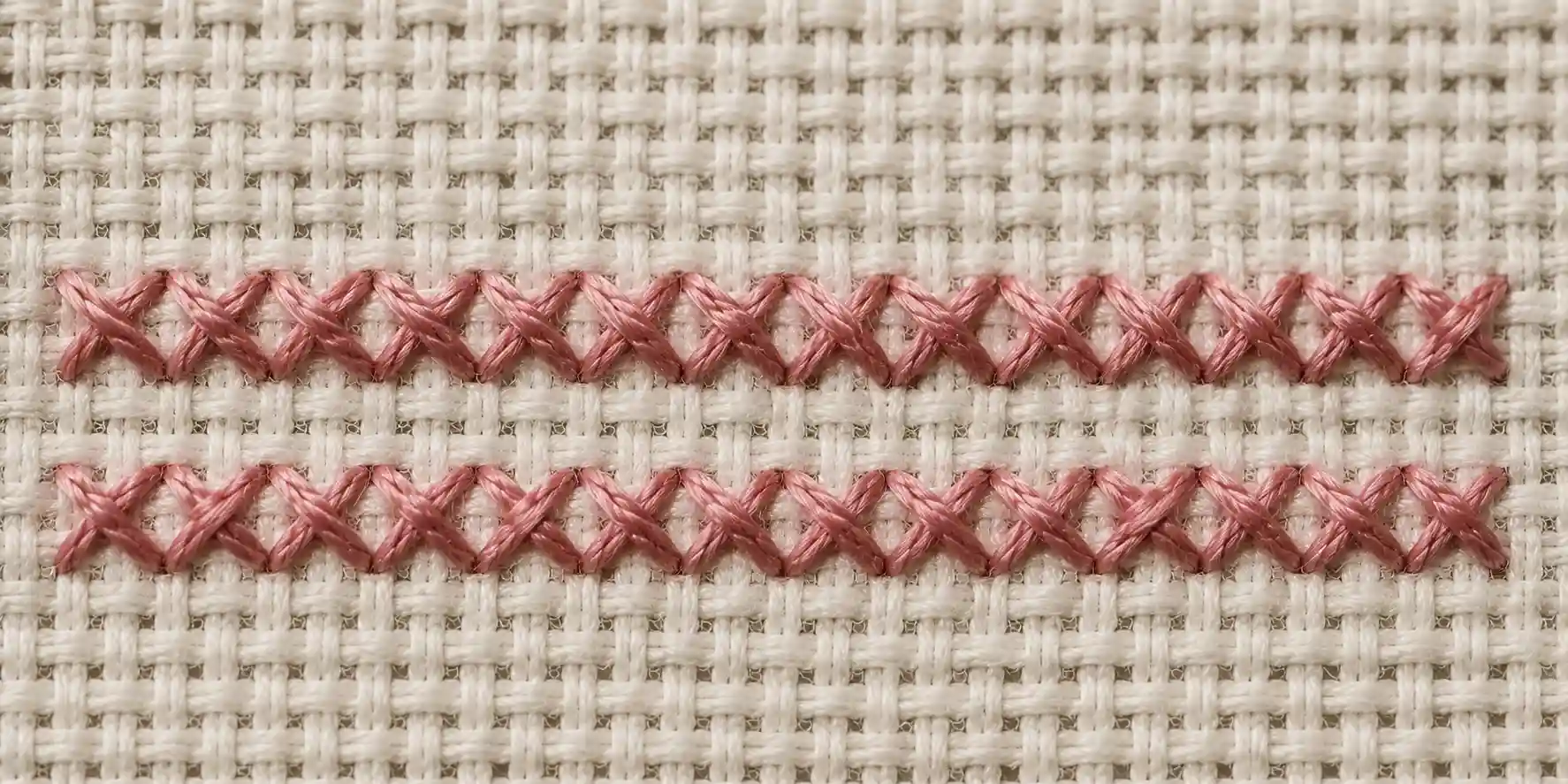
Every full cross stitch has a "top" diagonal - whichever of the two crossing stitches was worked last, sitting visibly on top of the other. Which direction that top stitch runs (bottom-left to top-right, or the reverse) doesn't affect the stitch's strength or size, but it does affect how light reflects off the thread. Stitched consistently, a whole piece has a uniform sheen. Stitched inconsistently, it reads as subtly patchy or textured in a way that's hard to pin down until someone points out the direction is mixed - I once spent ten minutes squinting at a finished piece before I realized that's exactly what had happened.
Consistent - every top stitch runs the same way.
Mixed - one stitch (shown here in a different color) breaks the pattern.
Why it happens
The most common cause isn't carelessness - it's switching between stitching methods mid-project. If you complete each cross fully before moving to the next square for part of a piece, then switch to the row method (half-stitches across, then back to complete them) for another part, the two approaches can naturally produce opposite top-stitch directions unless you're deliberately watching for it.
It also creeps in after a break: picking a project back up days or weeks later without checking which direction you'd been using is an easy way to introduce a visible seam of inconsistency partway through a section. This is exactly the mistake I made on my very first sampler.
How to stay consistent
- Pick a direction before you start (I always go top-right, but either is fine) and stick to it for the entire piece, including separate motifs stitched at different times.
- Use the row method - work the first diagonal of every square across a row, then return completing the bottom-left-to-top-right top diagonal on each one - since it structurally enforces the same direction for every stitch in that pass, rather than relying on remembering it stitch by stitch. It's genuinely the only reason I don't think about this anymore.
- Check before resuming a project you've set down for a while. I always look at a few recent stitches under good light before continuing, rather than trusting muscle memory to pick up where I left off.
- If you switch between working in hand and in a hoop, be aware that the fabric's orientation relative to your hands changes - it's a common moment for direction to flip without noticing.
A few inconsistent stitches in an otherwise uniform piece are rarely worth unpicking, in my opinion - this is a "front of mind while learning, no longer conscious once habitual" skill, not a strict rule I'd enforce stitch by stitch.
What it's used for
Keeping a finished piece looking uniform - every top stitch catching the light the same way rather than creating a patchy, inconsistent texture visible from across a room.