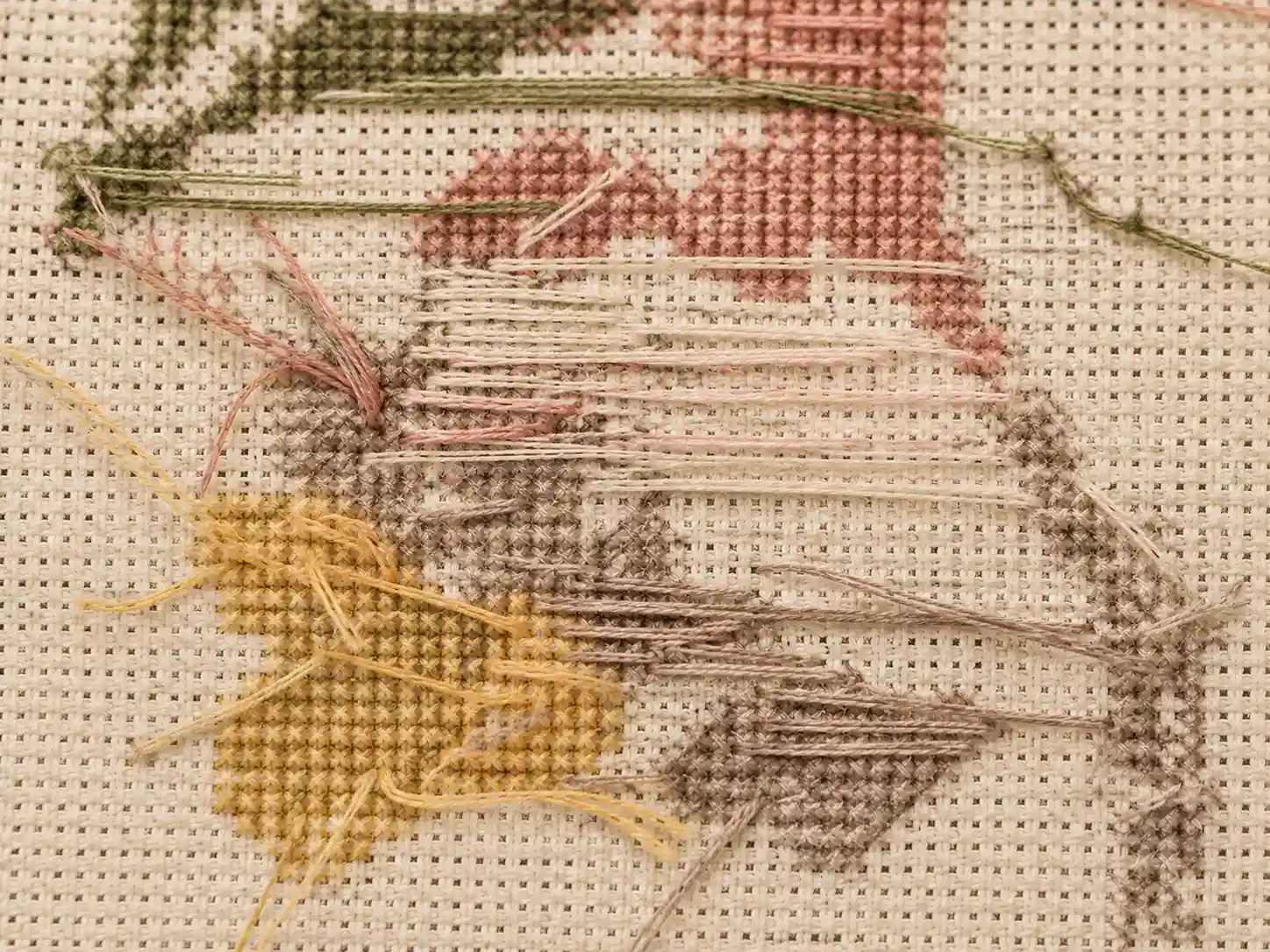
Once a design uses more than a handful of colors, how you manage thread between stitches starts to matter almost as much as the stitching itself, and this is a lesson I picked up the slow way - by tangling a lot of confetti-pattern projects before I learned to plan ahead. Three named approaches cover most of what I actually do.
Parking
Parking means bringing a thread you're not immediately using up to the front of the fabric and setting it aside - rather than finishing it off - because you know you'll need that same color again nearby soon. It's especially useful on designs where colors are scattered in small clusters across a wide area (confetti-style patterns are the classic case): instead of finishing and restarting the same color a dozen times, I park each color's thread at its next-use point and pick it back up when I get there.
The tradeoff is the back of the work: a heavily parked piece can end up with a lot of thread ends visible on the reverse, which some stitchers mind and others don't - I've made my peace with a messy back as long as the front is clean, but it's a purely cosmetic consideration unless the piece will be displayed unmounted or unbacked.
Looping (the loop start)
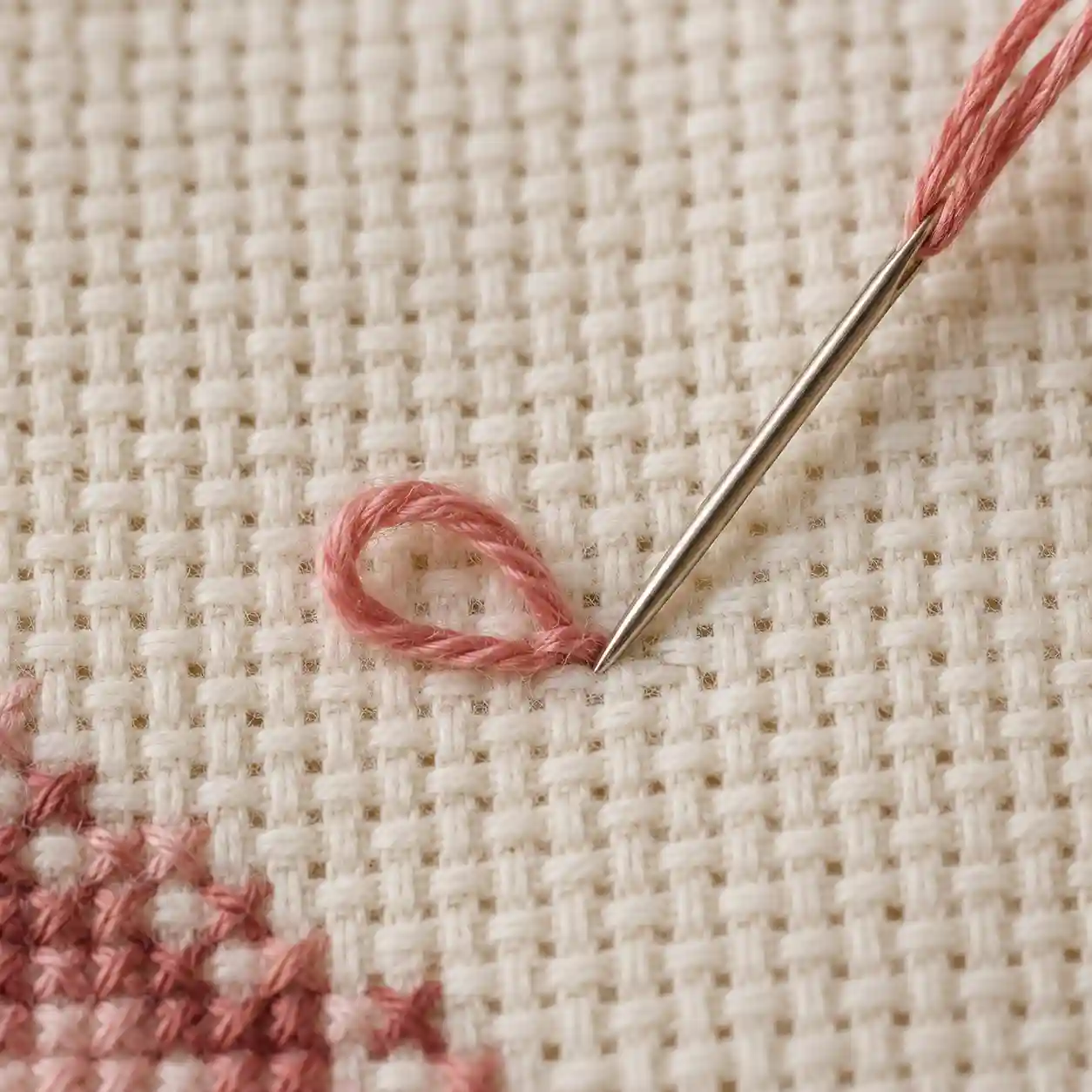
Looping refers to a specific way of starting a new thread, not managing it mid-project: fold a length of single-strand floss in half, thread the folded end through the needle, and take your first stitch so the loop catches on the back of the fabric instead of a knot. It only works with an even number of strands (typically two strands folded from one), but it's the tidiest, most secure knot-free start available, and it's the one I default to whenever the strand count allows it. See starting and ending threads for other no-knot starting methods when looping isn't an option.
Stringing (carrying thread on the back)
Stringing means simply carrying a working thread across a short gap on the back of the fabric to reach its next use, rather than finishing off and restarting. It's the simplest of the three approaches and needs no special technique - just run the thread under a few nearby stitches on the reverse to secure it as it crosses. My personal rule of thumb: carrying across a gap of a few stitches is fine; anything longer risks the strand showing through thin fabric or snagging when the piece is handled, and I'll reach for parking or a fresh thread instead.
Choosing between them
For most projects, I mix all three rather than committing to just one: string a color across small gaps, park a color I'll need again within the next few minutes of stitching, and cut and restart for anything further apart than that. There's no wrong choice as long as the back of the work stays reasonably tidy - it only becomes a real problem if it starts affecting front-side tension or is visible through a very open-weave fabric like linen.
What it's used for
Managing multiple thread colors efficiently in a design with lots of small, scattered blocks of color - deciding when to start a fresh thread, carry an existing one, or "park" it for later.