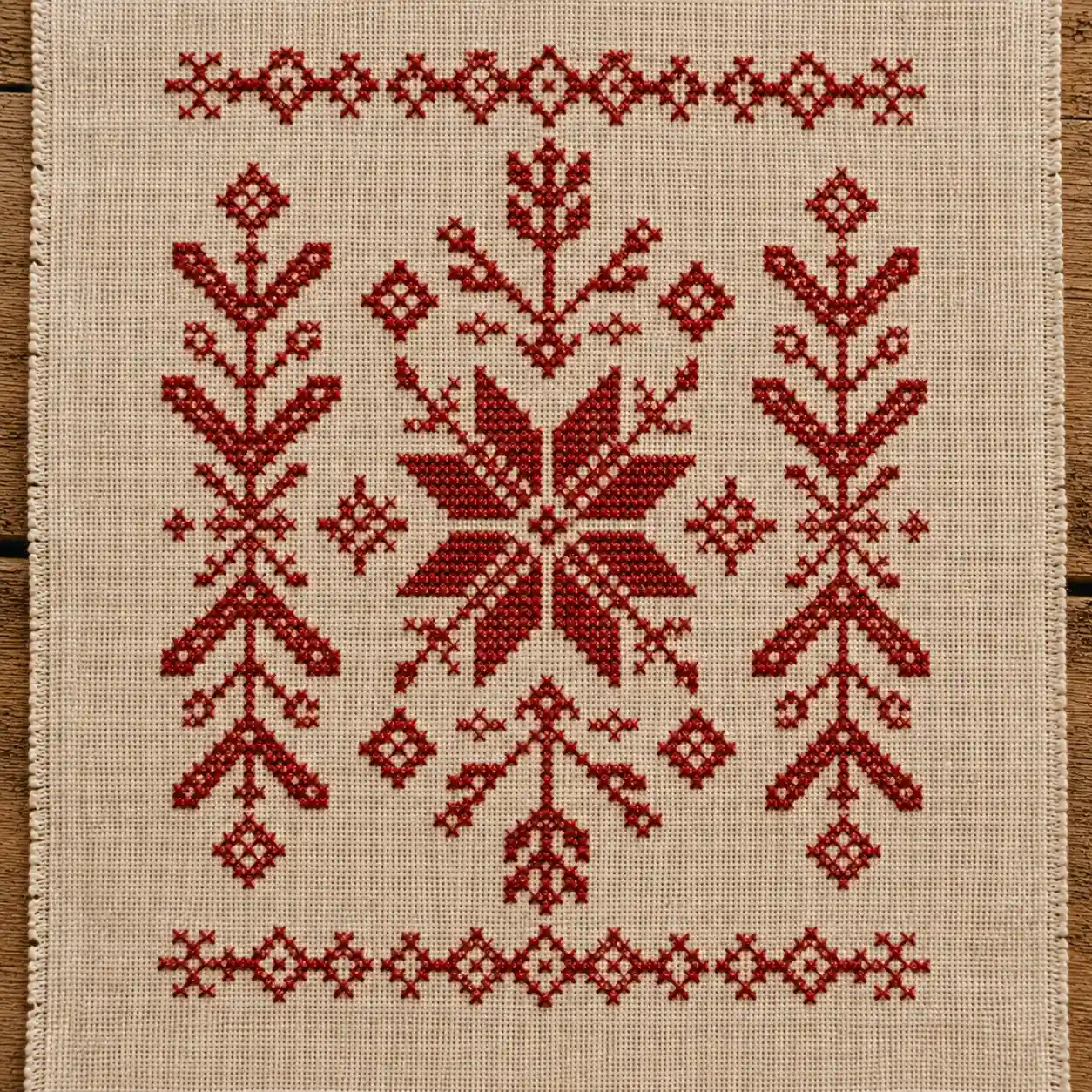
Most of this site's history section follows the European sampler-to-Victorian-parlour thread, because it's the lineage most directly connected to the hobby as it's practiced today. But I don't want that to imply cross-stitch is a European invention with everyone else as a footnote - counted-thread embroidery developed as its own distinct folk tradition in plenty of places, on its own timeline, for its own reasons. A few of the traditions I find most worth knowing about:
Hungarian folk embroidery
Hungarian folk embroidery covers several genuinely distinct regional traditions, and it's worth being precise about which is which rather than lumping them together. The densely floral Kalocsa and Matyó styles most people picture first are actually freehand embroidery - worked in stem and satin stitch rather than counted against a grid - so they're the most visually famous examples, not the counted-thread ones. The tradition closer to cross-stitch's own logic is separate regional counted-thread work, often worked in red or black on white linen, built from a small vocabulary of repeating, grid-based motifs passed down regionally rather than through printed pattern books. (A related but distinct Transylvanian tradition, írásos or "written embroidery" from the Kalotaszeg region, is sometimes mentioned in the same breath - but it's freehand chain stitch, not counted cross-stitch, and gets its name from the literal process: a "writing woman" first drew the design onto the linen by hand before it was stitched.)
Scandinavian counted-thread work
Scandinavia has a deep counted-thread tradition, most visibly in Hardanger embroidery - technically a distinct technique built around cutwork and satin-stitch blocks rather than cross-stitch itself, but close enough in spirit (geometric, counted, symmetrical) that the two traditions are often displayed and discussed together. Alongside it, regional Scandinavian cross-stitch proper shows up in traditional costume trim and household textiles, typically in strong, simple color combinations worked on linen.
Palestinian tatreez
Tatreez is a Palestinian embroidery tradition built substantially on cross-stitch, historically worked onto women's dresses (thob) with motifs and color combinations that could indicate a wearer's village or region - embroidery functioning as a legible marker of identity and origin, not unlike how a marking sampler once identified household linen. Tatreez has taken on renewed cultural and political significance in recent decades as a living link to Palestinian heritage, and it's a tradition worth reading about directly from Palestinian sources rather than solely through a general craft-history lens - this page is only a pointer, not the full story.
Why this matters for the rest of the site
I bring these traditions up here, in the history section, rather than treating them as a footnote, because I think it changes how you read everything else on this site. The "sampler to Berlin wool work to modern subversive stitching" arc is a real and well-documented history, but it's one thread among several, not evidence that cross-stitch was invented once and exported everywhere. If you're choosing fabric or floss for a project inspired by any of these traditions, the linen fabric guide is the closest match on this site to the ground these traditions are typically worked on - though I'd always encourage looking into a tradition's specific materials and motifs before borrowing from it.