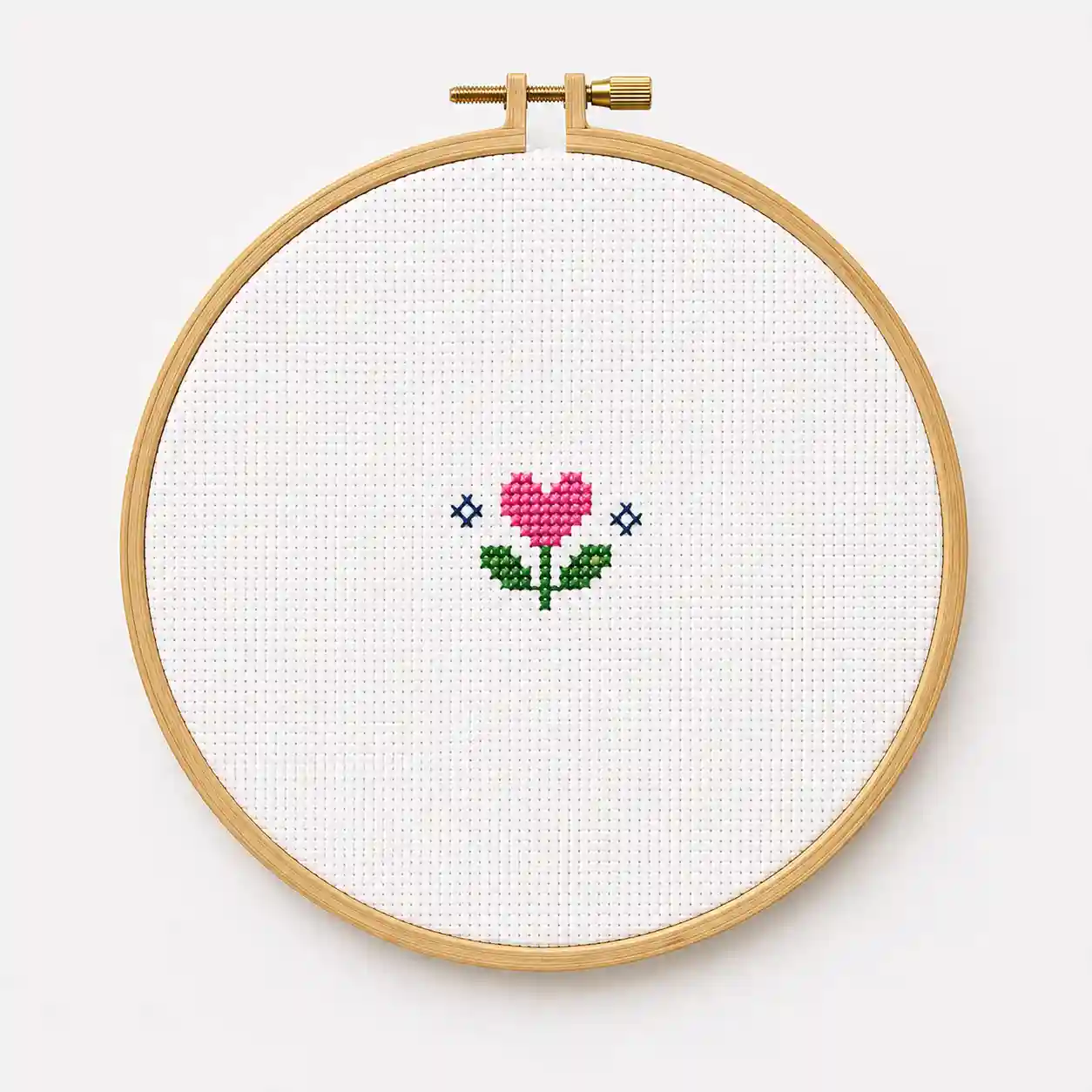
Set a minimalist cross-stitch piece next to a dense Berlin wool work sampler and you'd be forgiven for thinking they belong to entirely different crafts. Where Berlin wool work fills every available square, minimalist modern design does the opposite on purpose: a small motif, a single thin line, one word - surrounded by generous, deliberate empty fabric that's doing just as much visual work as the stitching itself.
Negative space as the actual design
The defining trait of this style isn't the motif - it's the restraint around it. A tiny geometric shape or a few words of text, hooped or framed with a wide margin of plain linen or Aida, reads as considered and calm rather than sparse or unfinished. That's a genuinely different design skill from a busy, motif-packed sampler: knowing how much to leave out, and trusting that emptiness reads as intentional rather than incomplete.
An older idea than it looks
I mentioned this on the Quaker samplers page and it's worth repeating here directly: restrained color, geometric abstraction, and generous negative space aren't a new invention of the modern craft-blog era. Quaker schools were producing needlework built on almost exactly these values a couple hundred years earlier, driven by religious plainness rather than contemporary design taste. Modern minimalist cross-stitch and historical Quaker samplers landed in a remarkably similar place by two completely unrelated routes, which I think is a genuinely useful thing to know if you assume "minimalist" only means "modern."
Where it sits next to florals
Minimalist and geometric work is often displayed as a deliberate aesthetic contrast to busier, more decorative styles - see modern floral and botanical cross-stitch for the fuller, more maximalist end of that same contemporary design spectrum. Plenty of stitchers move between both, using a spare geometric piece as a palate cleanser between more involved floral or pictorial projects.
A practical note on stitching it
Because these pieces are often small and displayed in a hoop rather than a full frame, they're a genuinely good format for practicing consistency - with so little stitching and so much visible plain fabric, any unevenness in tension or stitch direction is far more noticeable than it would be buried in a dense, busy design. See working in hand vs using a hoop or frame if you're planning to display the piece in the hoop itself, which minimalist designs are stitched for more often than most.
Try it: a project idea
Stitch a single small motif - one line of text, one simple shape - dead center on a piece of fabric several times larger than the design needs, and let the empty linen do real visual work.