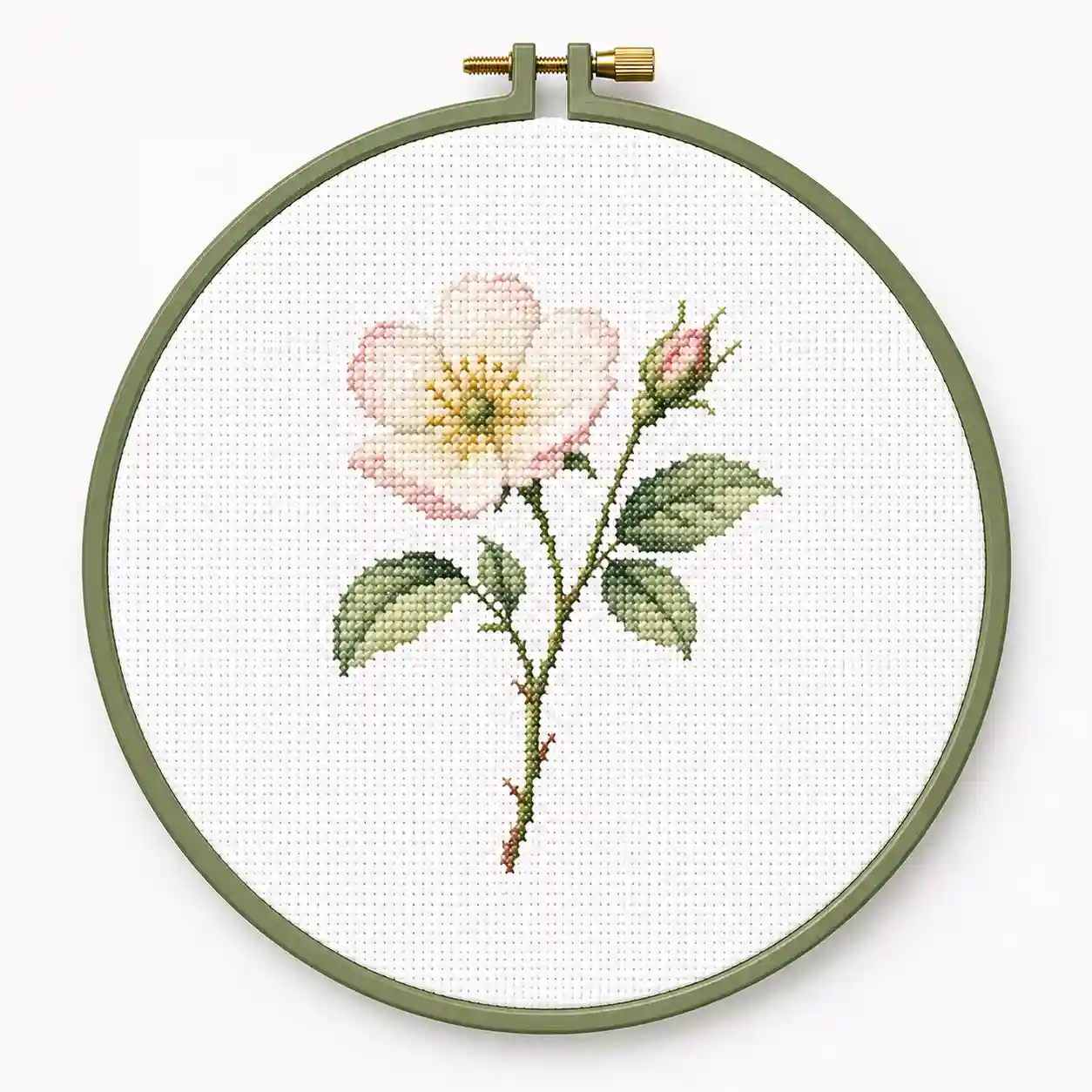
Florals have never actually left cross-stitch - they're one of the few motifs present in nearly every era covered on this site, from early sampler borders through the Berlin wool work craze and straight through to today. What's changed is the treatment: modern botanical cross-stitch takes the same subject and renders it with a noticeably different visual language than its historical ancestors.
What actually reads as "modern" here
Where Berlin wool work favored bold, saturated, flatly blocked color and dense coverage, modern floral design tends toward softer, blended color transitions across a single petal or leaf (several close shades of one hue rather than one flat color per shape), looser, more organic linework instead of rigid, symmetrical repeats, and - often - a botanical illustration sensibility, closer to a scientific plant study than a decorative repeating motif. It's less "pattern" and more "portrait of a specific plant."
Botanical illustration as the real influence
I'd argue the strongest modern floral cross-stitch design borrows more directly from botanical illustration traditions - precise, observational plant drawings - than from any earlier needlework style. That shows up in small but telling details: leaves rendered with visible vein structure rather than as flat green shapes, stems with believable curve and shadow, and compositions that isolate a single stem or cutting rather than repeating a motif across a border. It's a different discipline being translated into stitches, not a straight evolution of the Berlin wool work rose.
A technical note: blending color smoothly
Getting that soft, blended-shade look usually depends on comfort with fractional stitching for organic curves - see half cross stitch for the technique that lets a curved petal edge read smoothly rather than in stair-stepped blocks - plus a willingness to use several close shades of the same color family rather than a single flat one, even where a simpler chart might get away with just one.
The contemporary aesthetic pairing
Modern floral work is frequently paired, in shops and portfolios, with the exact opposite aesthetic: minimalist and geometric design. The two get displayed together often enough that I think of them as two ends of the same contemporary design sensibility - one lush and organic, one spare and restrained - both defined in opposition to the dense, saturated maximalism of the Victorian era that came before both of them.
Try it: a project idea
Chart a single, specific plant from your own life - a houseplant on your windowsill, a flower from a particular bouquet - rather than a generic stock floral motif, using loose, painterly color blending instead of a flat single shade per petal.