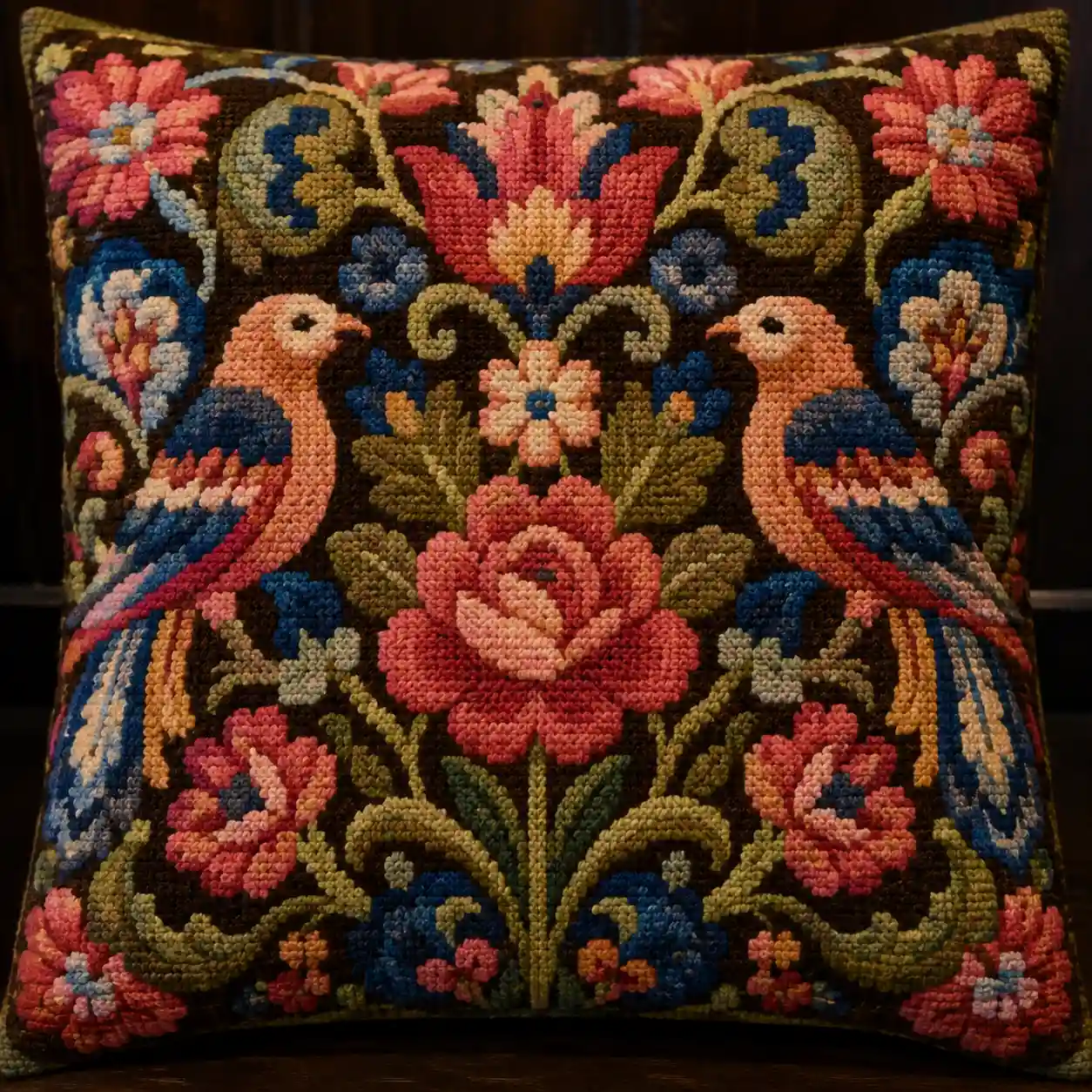
If the alphabet sampler is cross-stitch at its most restrained, Berlin woolwork is the exact opposite instinct taken to its logical extreme, and I have a real soft spot for it precisely because of that excess: dense, richly colored, deliberately showy needlework, worked in wool rather than fine floss, that turned into arguably the biggest craft craze the hobby has ever seen.
What made it distinct
Berlin wool work gets its name from Berlin, where the printed, hand-colored charts driving the style were first published and exported across Europe and eventually America - see the Victorian revival for the fuller cultural picture. Stylistically, it's defined by a few clear traits: thick, soft wool worked over canvas rather than the finer linen and silk thread of earlier samplers, bold florals, exotic birds, and elaborate scrollwork borders, and an overall density - every square of the canvas filled, with little to no plain background left showing.
That density is really the point. Where a restrained alphabet sampler leaves generous open linen around its motifs, a Berlin wool work piece is meant to read as lush and abundant, closer in spirit to an oil painting or a tapestry than to the modest reference sampler it descended from.
Wool, canvas, and 3D texture
Because it was worked in wool on a coarser canvas rather than fine linen, Berlin wool work also allowed for techniques earlier samplers rarely used at scale - raised, plush stitching (sometimes called "plush stitch") that stood up off the surface for a genuinely three-dimensional, almost velvet-like texture on flowers or animal fur. This is a meaningfully different physical object from a flat, fine-linen sampler, and it's part of why Berlin wool work pieces were so often used for upholstery, footstools, and firescreens rather than framed as pictures - they were built to be touched and used, not just looked at, which I think is part of what makes them feel so alive to me even now.
An industry, not just a style
Berlin wool work is inseparable from the printed-chart industry that made it possible - see how patterns evolved from kits to counted charts for that publishing history in full. Unlike a sampler copied stitch-by-stitch from another finished piece, a Berlin chart was a mass-produced, purchasable object in its own right, meaning the same design could be stitched, in the same bold colors, by households across an entire continent. That's a genuinely different relationship to a pattern than anything the sampler tradition had seen before, and it's the direct ancestor of the commercial kit-and-chart format the hobby still runs on.
Try it: a project idea
Pick one Berlin-woolwork-style motif - a stylized rose or a small bird - and stitch it in the boldest, most saturated wool or floss colors you own, leaning into the density rather than restraining it.