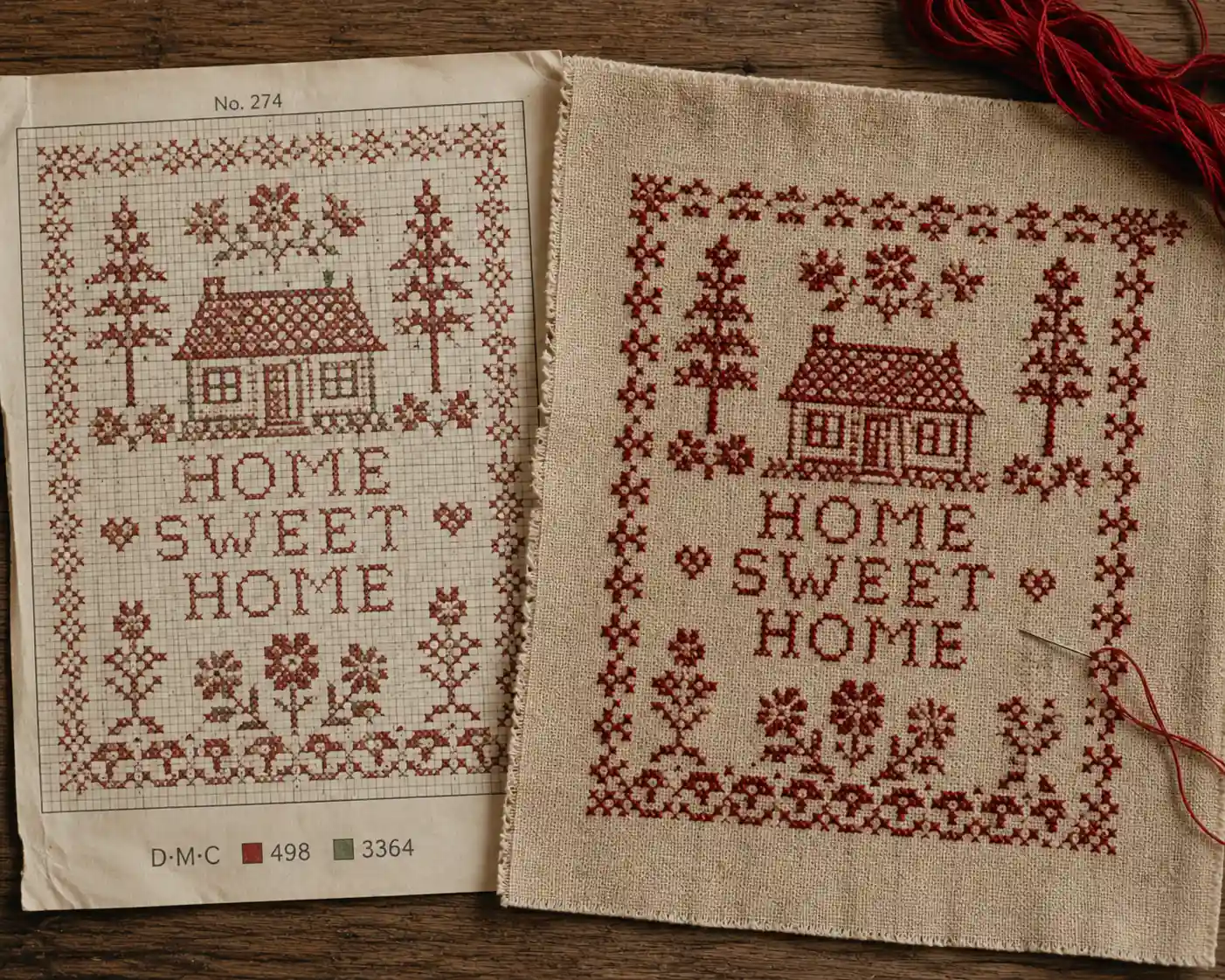
This is a niche corner of the history section, but it's the one I'd point to if someone asked me why cross-stitch looks and works the way it does today. Every other page in this section is about who stitched and why - this one is about how the instructions themselves traveled, which turns out to explain a surprising amount.
Copying by eye
For most of the sampler era, patterns weren't a separate object at all. A motif spread by direct observation: a stitcher copying a border or letterform from another finished piece, from memory, or from informal notes, one stitch counted at a time. This is slow and imprecise by modern standards, but it's also why regional and family styles could stay so distinct - a motif drifted slightly every time it was copied by eye, the same way a story changes slightly with each retelling.
The printed chart arrives
The Victorian era changed this fundamentally. Printed, gridded, hand-colored charts - the format behind the Berlin wool work boom - meant a design could be reproduced exactly, at scale, and mailed to a stitcher who had never seen the original piece it came from. This is the moment "pattern" becomes a product rather than borrowed knowledge: something designed once, printed many times, and sold rather than passed down.
That single shift - separating the design from the stitching - is what made a real publishing and retail industry around cross-stitch possible for the first time.
The kit format
By the 20th century, as hand needlework moved from default household skill to hobby (see 20th-century decline and revival), the industry responded by lowering the barrier to entry even further: the kit. A kit bundles a pre-printed or pre-stamped design directly onto the fabric, floss pre-sorted and labeled, and a simplified chart, so a total beginner can start stitching without first learning to read a chart from scratch or source materials separately. It's a genuinely clever solution to a real problem - needlework literacy was no longer something most people arrived with by default, so the product adapted around that gap.
Counted charts and the modern hobbyist
Alongside kits, the counted cross-stitch chart - a symbol-and-color grid worked onto plain, unmarked fabric rather than a pre-stamped design - remained the format of choice for more experienced stitchers, since it allows any fabric count or color substitution without being locked to a specific pre-printed piece of cloth. This is the direct descendant of the Victorian printed chart, refined over a century into the standardized symbol-and-key format used almost universally today. If you're new to reading one, how to read a cross-stitch pattern or chart walks through exactly how a modern chart is structured, and the abbreviations and symbols glossary covers the shorthand that's accumulated along the way.
Digital patterns
Most recently, the same format has simply moved formats again rather than changing in substance: PDF and app-based charts, sold and delivered digitally, designed in dedicated pattern software rather than hand-drawn. The symbol-and-key grid itself, though, is still recognizably the same object the Victorians industrialized - proof that a good-enough format, once it's standardized, tends to outlast the technology used to distribute it.