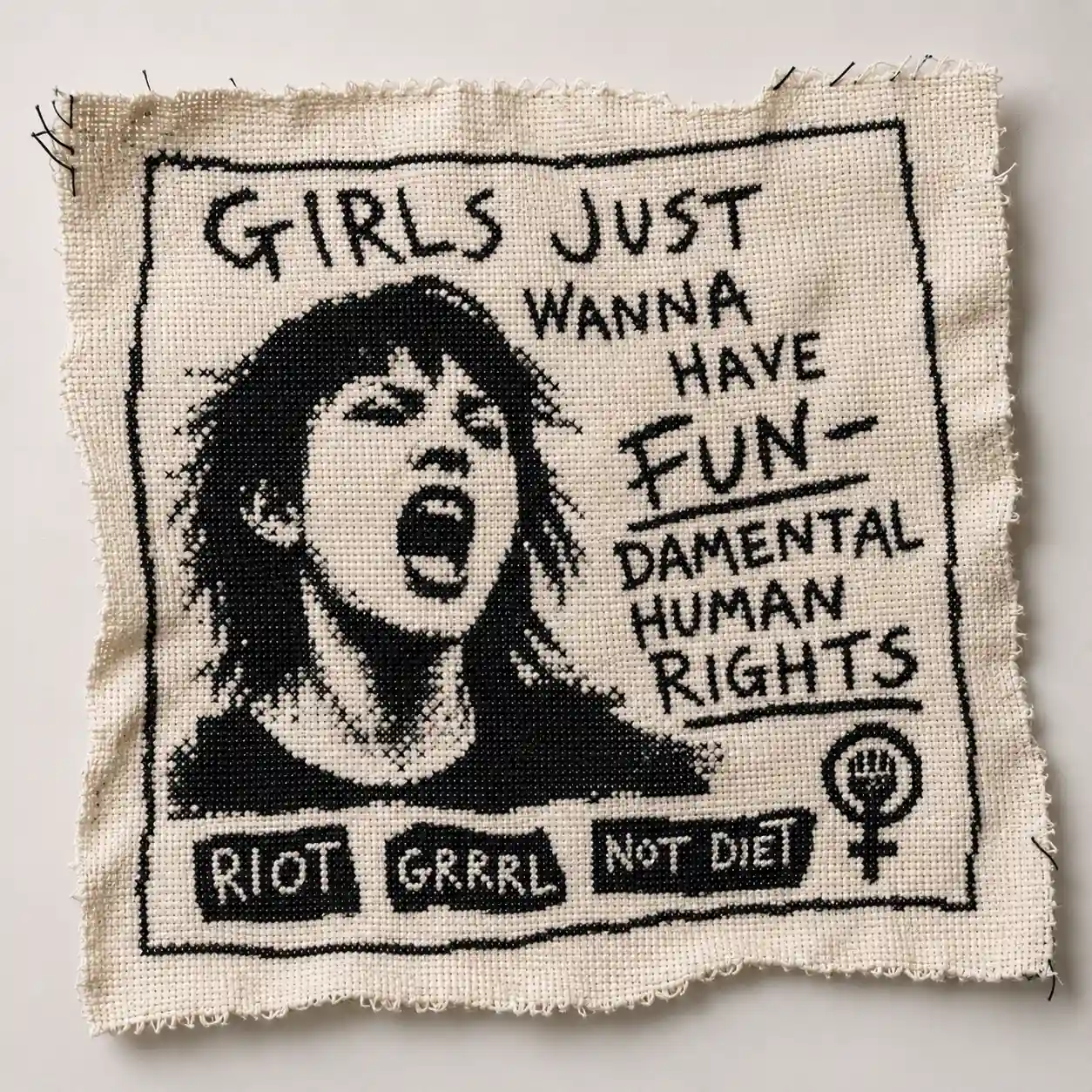
This page is really the connective tissue of the whole site - it's where the history section hands off to the modern one. If you've read 20th-century decline and craft revival, you already know the setup: cross-stitch spent much of the 20th century as a quiet, nostalgic, slightly old-fashioned hobby craft. This is the story of what happened when a new generation decided that reputation was exactly the point.
The 1990s groundwork
The cultural groundwork for subversive cross-stitch was laid in the 1990s, when a wave of punk, riot grrrl, and third-wave feminist culture began actively reclaiming domestic and "feminine" crafts - not by rejecting them as regressive, but by using them as a medium for exactly the kind of blunt, confrontational, funny, or political content they'd never traditionally carried. The clearest documented example of that reclaiming in this specific era is knitting, not cross-stitch - Stitch 'n Bitch knitting circles started forming in the late 1990s, openly mixing craft with punk and feminist politics. Cross-stitch's own version of that reclaiming crystallized a little later, but once it arrived, it had an obvious advantage: with its centuries of prim, wholesome reputation, cross-stitch was arguably the single best-suited craft for this kind of pointed inversion - nothing else came pre-loaded with quite so specific a "proper young lady" association to push against.
The 2000s: publishing gave it a name
What actually turned this into a recognizable movement, in the early-to-mid 2000s, was publishing: independently published pattern books put out explicitly sweary, subversive, or politically pointed cross-stitch charts, making the style accessible to stitchers who wanted the joke without designing their own chart from scratch. That's the same publishing-driven acceleration that turned Victorian Berlin wool work from a niche pastime into a genuine craze a century earlier - a distinctive style needs a way to spread beyond its originators to become a movement rather than a handful of individual pieces.
The internet did the rest
If print publishing got the movement started, the internet is what turned it into the dominant modern image of cross-stitch it is today. Image-sharing platforms and online craft marketplaces gave subversive pieces - inherently visual, inherently shareable, built for a quick laugh or a sharp reaction - an ideal distribution mechanism. A funny or blunt sweary sampler photographs well, travels well, and needs zero context to land, which made it exactly the kind of content that spreads fastest online. Snarky and sweary cross-stitch in particular owes a huge amount of its current visibility to exactly this online-shareability effect.
A knowing continuation, not a rebellion
I want to end on the point I think matters most across this entire site: subversive cross-stitch isn't a rejection of the sampler tradition - it's a genuinely knowing continuation of it. Verse samplers always used the format to say something with real weight. This movement is doing the same structural job, for a new generation, with very different words. Once you see it that way, the "internet's favorite ironic craft" starts looking less like a joke about cross-stitch's history, and more like one of the most faithful things happening to it.
Try it: a project idea
Look up one of the early published subversive cross-stitch books or patterns and stitch a piece directly inspired by that first wave - a small way of tracing the style back to where it actually started.