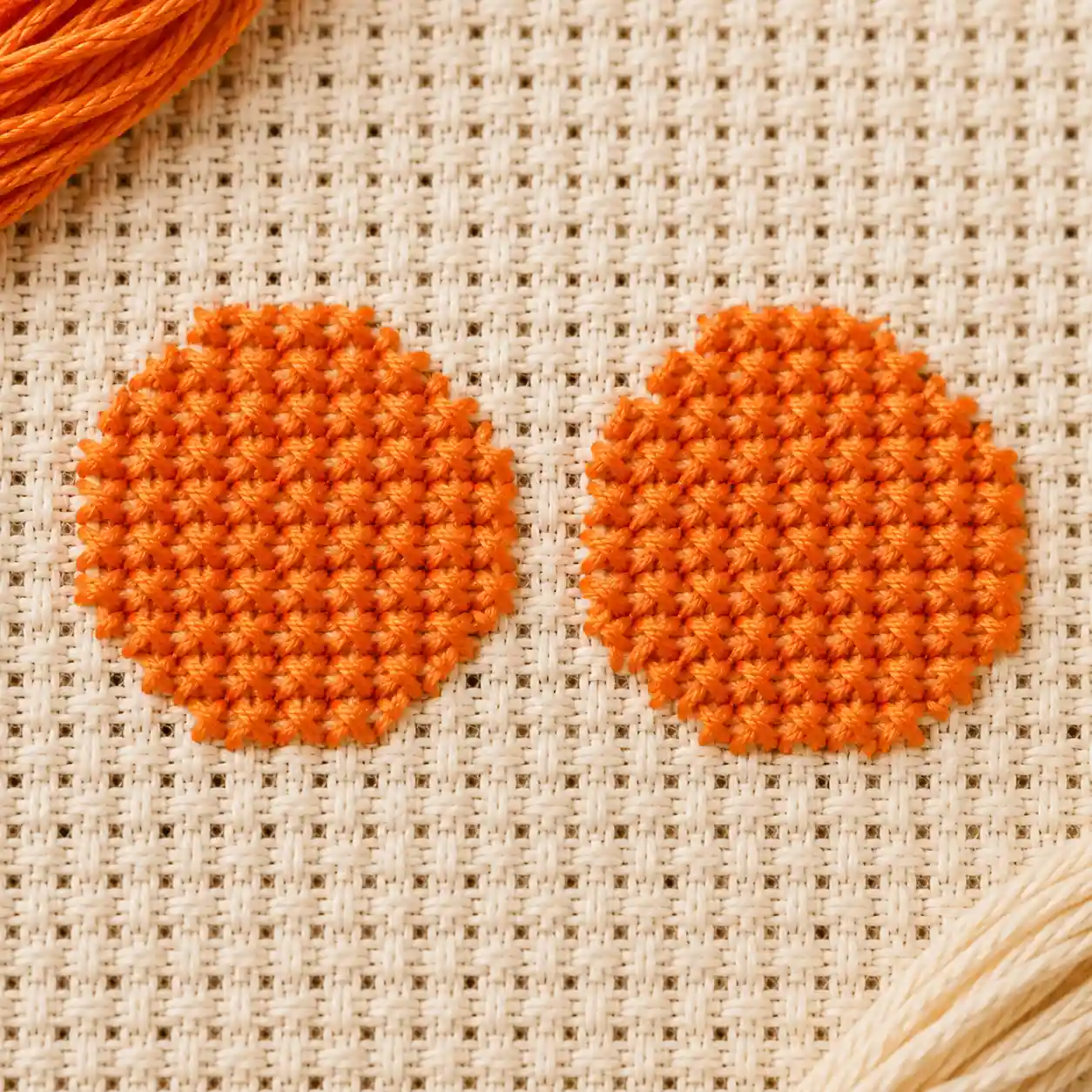
Quarter and three-quarter stitches are fractional cross stitches used to add detail finer than the fabric's grid normally allows, and they're the technique I lean on whenever a design needs to feel less "blocky" than a straight grid of squares. They rely on a property of woven fabric: at the center of each Aida block (or evenweave/linen intersection), there's a small hole where the four threads that form the block's corners meet in the middle. A quarter stitch uses that center hole as one of its two anchor points instead of a full corner.
Quarter stitch
Up at 1, down into the center hole at 2.
- Bring the needle up at one corner of the square.
- Instead of crossing to the opposite corner, insert the needle down into the center hole of the square.
That's a single diagonal quarter-length stitch, covering one triangular quarter of the block. On its own it's used sparingly - mostly for very fine detail - because it leaves three-quarters of the square's fabric exposed.
Three-quarter stitch
Half stitch 1→2, plus a quarter stitch 3→4 into the center.
A three-quarter stitch is a quarter stitch plus a half stitch layered on top, together covering three of the block's four triangular quarters:
- Work a half cross stitch as normal (corner to opposite corner).
- Add a quarter stitch from one of the two remaining corners into the center hole, on top of the half stitch.
The result is a stitch with one straight edge and one pointed corner - the standard way patterns represent a diagonal or curved edge without a harsh staircase step. Charts mark these with a triangular (rather than square) symbol, split to show which corner is "missing."
A few notes
- Quarter and three-quarter stitches only work cleanly on fabric with a visible center hole per block - this is most Aida cloth. Some evenweave and linen can be trickier since the "center" is less clearly defined; I always check my fabric before committing to a design that leans heavily on fractional stitches.
- They're more fiddly and slightly slower than full or half stitches, which is why I only reach for them where they meaningfully improve the shape - mainly curves, circles, and small facial features. I don't bother anywhere else; it's not worth the extra time.
What it's used for
Softening curves, circles, and diagonal edges - anywhere a design needs finer detail than a full grid of squares can represent, such as rounded petals, faces, or small text.