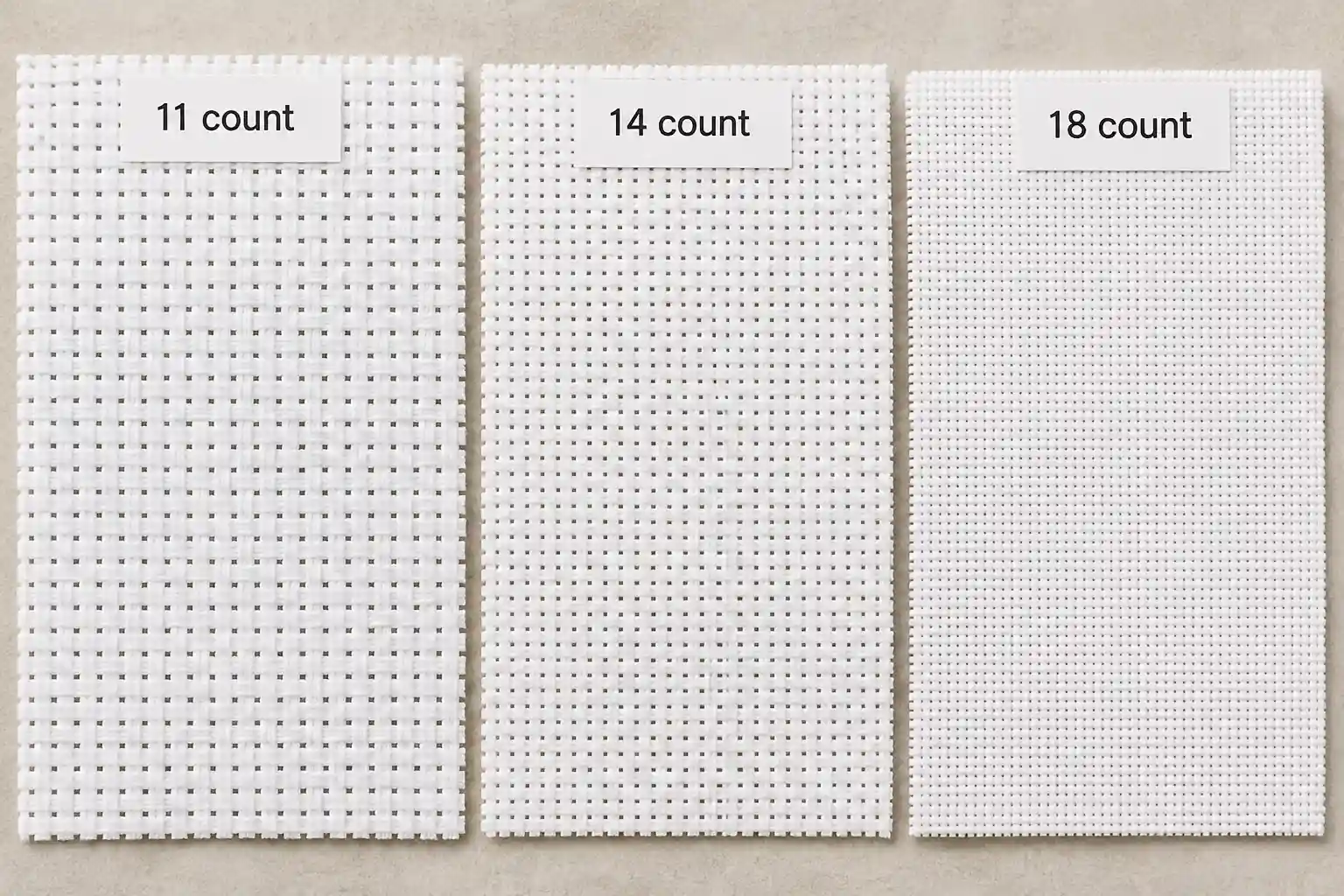
Aida is the fabric most people learn on, and "count" is the single most important number on the label - it's what determines how big your finished piece will be and how easy the fabric is to work on. Here's what each common count actually looks like in practice.
What "count" means
Aida count is the number of squares (and therefore stitches) per inch of fabric. It's woven with a visible, blocky grid structure specifically so each square holds exactly one full cross stitch - no counting individual threads required, which is what makes Aida the easiest fabric to start on. A chart's stitch count stays the same regardless of fabric count (see how to read a cross-stitch pattern); what changes is only the physical size of the finished piece. Higher count means smaller squares, more stitches per inch, and a smaller finished piece for the same design - the fabric size calculator does this math for you directly.
Common counts, and where each one shines
- 11 count - The largest, easiest-to-see squares. Good for young or beginning stitchers, low-vision work, or anyone who wants a quick, chunky result. Floss coverage is thick (usually 3 strands), so designs read bold rather than fine.
- 14 count - The default recommendation for most beginners and the most common count for commercial charts and kits. Small enough to look "properly" cross-stitched, large enough to see clearly without strain. If you're not sure what to buy, start here.
- 16 count - A step up in detail for roughly the same ease of handling as 14 count. A good next step once 14 count feels comfortable, especially for designs with a lot of fine detail packed into a modest size.
- 18 count - Noticeably finer. Popular for detailed pictorial pieces and smaller finished sizes without needing a huge design. Usually worked with 2 strands rather than 3.
- 22 count (sometimes called Hardanger Aida) - Fine, dense work, usually reserved for advanced stitchers or highly detailed miniatures. Worth trying once you're confident with tension and consistent stitch direction (see stitching direction and consistency), since small counting errors are much less forgiving at this scale.
Why I usually recommend starting at 14
I think 14 count is the right default for almost everyone starting out, not because it's the "correct" choice, but because it splits the difference well: your stitches are still large enough to correct comfortably if you miscount, but small enough that you're not fighting oversized squares on a design that wants finer detail. Once you've got a finished 14-count piece under your belt, moving up or down a count is a much easier decision to make with real experience behind it.
Matching count to a design
If you're choosing fabric for a specific chart rather than a pre-kitted project, the deciding factor is usually finished size: a 150×150 stitch design comes out roughly 13.6" square on 11 count, but under 7" square on 22 count. Run your chart's stitch dimensions through the fabric size calculator before buying fabric - it's a much better way to choose count than guessing from a swatch alone.