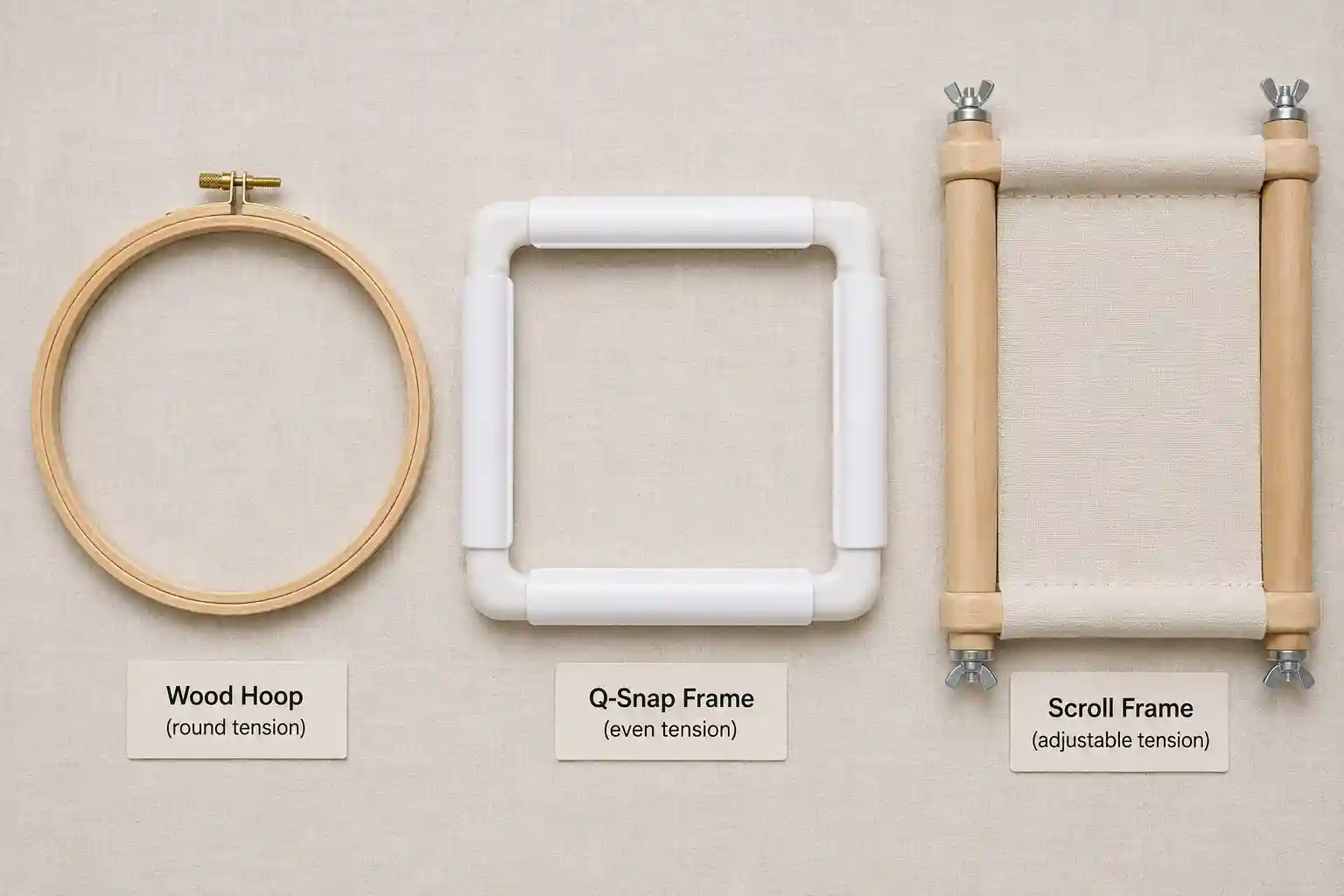
Once you've decided you want fabric held taut rather than working in hand (see working in hand vs using a hoop or frame for that first decision), the next choice is which holding tool actually suits your project. The three main options each solve the "keep fabric taut" problem a little differently.
Embroidery hoops
A hoop is two concentric rings - usually wood or plastic - that sandwich the fabric between them, held taut by tightening the outer ring. It's the cheapest, most widely available option, and it's genuinely good for smaller projects and pieces you plan to display in the hoop itself, which a lot of minimalist and modern designs are made for specifically.
The trade-off is that a hoop only holds a fixed area of fabric taut at a time - for a large project, you'll need to reposition it repeatedly across the piece, and a hoop left clamped on finished stitching for too long can leave a visible crease, which is worth planning around if you're not stitching the piece specifically to display in that hoop.
Q-Snap frames
A Q-Snap is a rigid, four-sided frame of PVC tubes with separate snap-on plastic clamps that clip fabric taut against the tubes along all four edges at once, rather than sandwiching it between two rings. It holds a larger, evenly tensioned area than a hoop of comparable size, doesn't leave the same crease risk since nothing is clamped directly onto stitched fabric, and it's simple to reposition by unsnapping and resnapping a section. It's a good middle-ground choice for medium-to-large projects where a hoop feels too small but a full scroll frame feels like overkill.
Scroll frames
A scroll frame holds fabric taut along two rollable bars, with the fabric's excess length rolled around the bars rather than left hanging loose, letting you work a much larger design methodically from one end to the other without ever leaving fabric unsupported. It's the setup most serious large-project and heirloom-sampler stitchers reach for eventually, since it keeps tension extremely even across a big piece and protects rolled-up sections from creasing or handling wear during long projects.
The trade-off is upfront cost and a slightly more involved setup - mounting fabric onto a scroll frame's bars takes more time than snapping on a Q-Snap or popping fabric into a hoop, which makes it a poor fit for a quick, small project even though it's the best option for a large one.
Which to actually pick
For a first project, I'd default to a simple hoop - it's cheap, it's forgiving, and it teaches you to feel even tension (see stitching direction and consistency for why that consistency matters) before you invest in anything more specialized. Move to a Q-Snap once you're working pieces too large for a hoop to comfortably cover, and consider a scroll frame once you're taking on genuinely large, long-term projects where even tension over months of work matters more than setup convenience. Whichever you use, remember that even tension while stitching still benefits from proper blocking once the piece is finished - no holding tool fully replaces that final step.