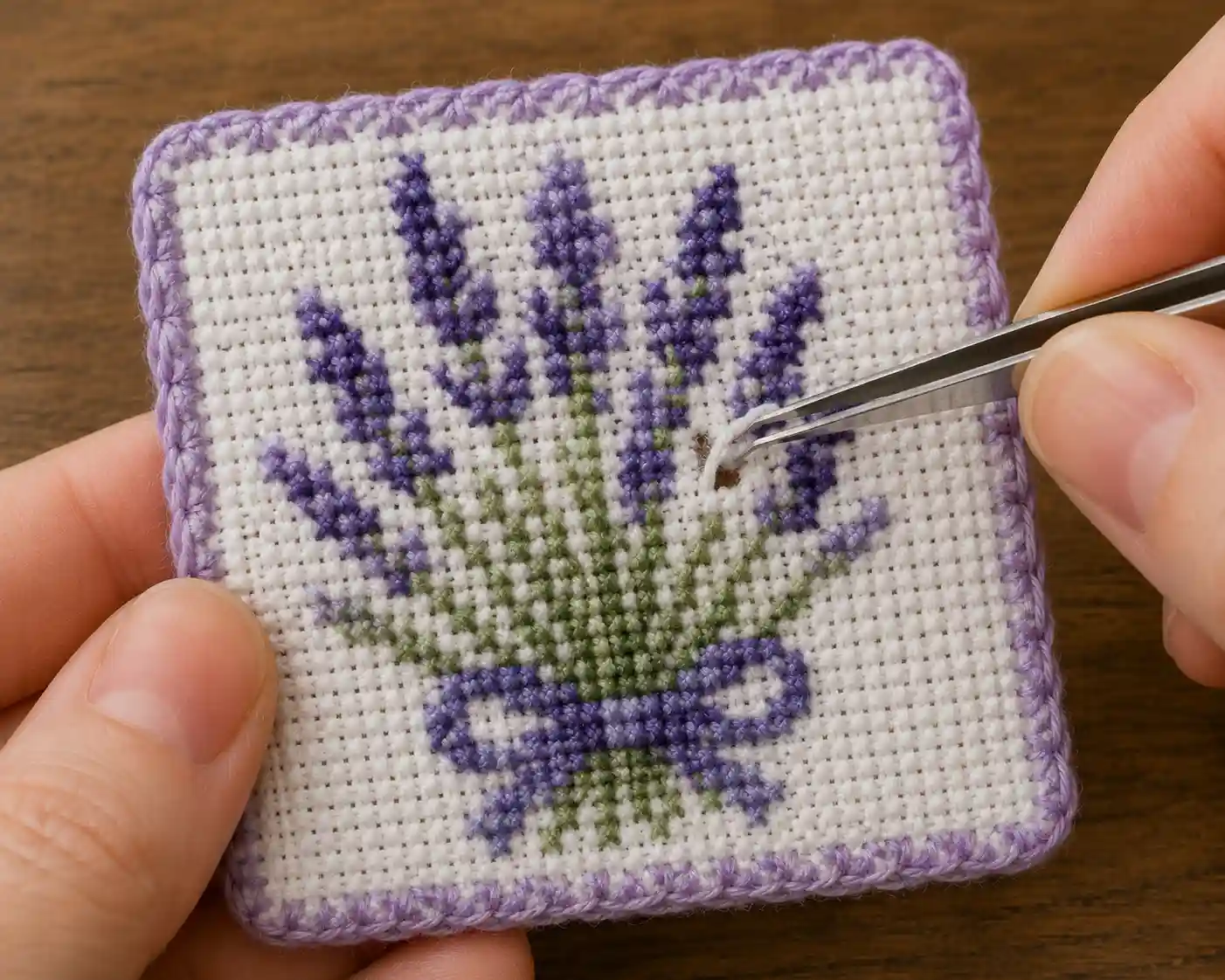
Every stitcher makes mistakes - the difference between a frustrating project and a manageable one is usually just knowing how to fix the specific problem in front of you rather than panicking and unpicking far more than necessary. Here are the most common issues and the fastest fix for each.
A single miscounted stitch
If you spot one wrong stitch surrounded by correct ones, there's no need to unpick anything beyond it. Use the tip of your needle (or a pair of small embroidery scissors held carefully) to snip just that stitch's threads on the front, then use tweezers or the needle's eye to pull the cut threads out from the back. Re-stitch just that single square once it's clear. This is far faster than unpicking backward row by row for an isolated error.
A miscounted section (several stitches off)
If a whole cluster of stitches has drifted off-count - usually discovered when a motif suddenly doesn't line up with the chart anymore - it's worth unpicking back to the last point you're confident was correct, rather than trying to patch around the error. Work backward stitch by stitch using your needle to lift and remove each one in reverse order, checking your chart position frequently as you go. Resist the urge to just "shift" the remaining design to hide a miscount; it reliably compounds into a much bigger problem a few rows later.
Uneven tension or visibly twisted stitches
If a section looks slightly puckered, gappy, or has visibly twisted-looking stitches, this is usually a tension or stitch-direction consistency issue rather than a counting error - see stitching direction and consistency for the underlying cause. Often this smooths out considerably once the piece is blocked and washed, so it's worth waiting until that stage before deciding a section needs to be redone.
A knot or tangle mid-project
If your working thread knots or tangles on itself, don't yank it - pulling a snag tight usually turns a minor annoyance into a genuine problem. Instead, gently work the tangle loose with the tip of your needle, or if it won't release easily, cut the thread at a natural stopping point, secure the tail using a proper no-knot ending method, and restart with fresh floss. A small amount of thread conditioner (or running floss lightly through beeswax) can reduce tangling on long working threads, especially with certain specialty threads.
When a mistake isn't actually worth fixing
Not every tiny inconsistency needs correcting. A single stitch with very slightly uneven tension, invisible from normal viewing distance and likely to smooth out during blocking, is rarely worth unpicking and redoing - the goal is a piece that reads as well-made at a normal glance, not one that's been picked apart and restitched into exhaustion over an error only the maker will ever notice. I'd save the unpicking effort for mistakes that actually throw off the design's alignment or are clearly visible once finished.