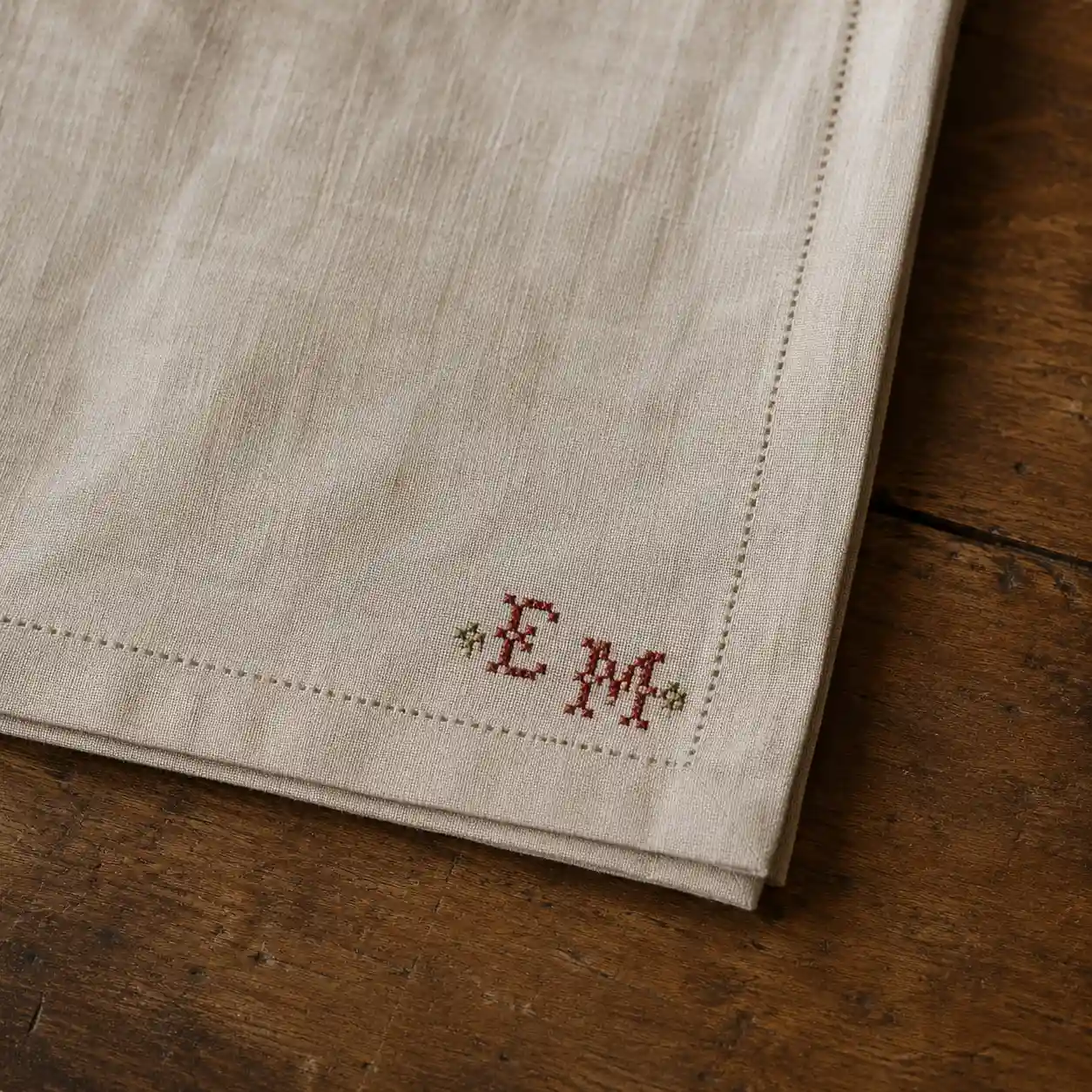
Of everything in this section, marking samplers are the one I think best captures how unglamorous cross-stitch's origins really were. This isn't decorative work made to be admired - it's a practice sheet for a genuinely tedious but essential household task: labeling linen so it could be tracked, laundered, and returned to the right owner.
A real logistics problem
Before ready-made, mass-produced linens, a household's sheets, towels, napkins, and shirts were valuable, hand-made or hand-finished items, often shared across a large household or sent out to a communal laundress. Once several near-identical pieces of linen left the house together, there needed to be a way to tell them apart and get them back to the right owner. The solution was to stitch a small mark - usually initials, sometimes a running number as well - directly onto each piece, in a spot that would survive years of washing and use.
A marking sampler was where a girl practiced exactly this: rows of letters and numerals, worked small, in a consistent, durable stitch, meant to be reproduced later on actual household items rather than admired as a finished composition. It's the most purely functional sibling of the alphabet sampler - same core skill, entirely practical purpose.
Why cross-stitch specifically
Small, counted cross-stitch marks were well suited to this job for reasons that echo cross-stitch's whole history: worked on a countable linen weave, letters could be reproduced accurately and small, in a stitch durable enough to survive repeated hot washing and wringing, using thread that wouldn't bleed or fade the way some dyes of the era did. A marking sampler's alphabet, in other words, wasn't chosen for how it looked - it was chosen because it held up.
A quieter kind of record
Marking samplers rarely survive in the same numbers or with the same fanfare as ornate verse or Berlin woolwork pieces, and I think that's exactly why they're worth knowing about. They represent needlework as pure, unglamorous utility - the same skill set that produced show-piece samplers, pointed instead at laundry management. If you find the record-keeping angle of samplers interesting generally, family record samplers push that same identifying, tracking impulse in a very different, far more sentimental direction.
Try it: a project idea
Mark a real household item - a tea towel, pillowcase, or handkerchief - with a small initial-and-number combination in one corner, the way a genuine marking sampler's alphabet was actually put to use.