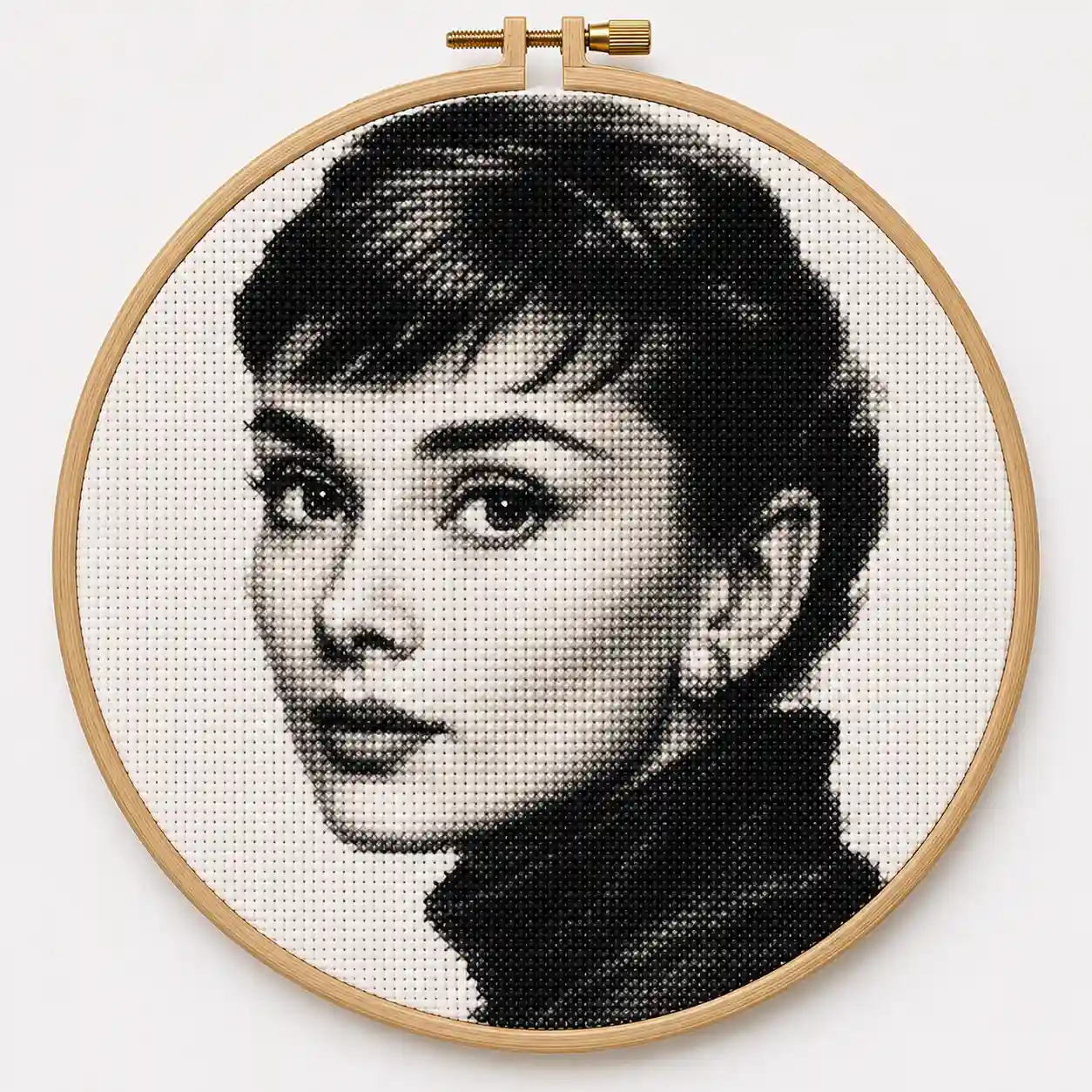
If pop culture and fandom cross-stitch works by keeping things small and iconic, this style is the deliberate opposite bet: full detail, full tonal range, an actual likeness rendered in thread - the single most technically demanding style covered on this site.
Why this is genuinely hard
A photograph has continuous tone - smooth gradients of light and shadow with no hard edges. Cross-stitch is a grid of discrete, fixed-size colored squares. Translating one into the other means approximating a smooth gradient using blocky, stair-stepped color transitions, at a scale fine enough that the eye blends adjacent squares into something that reads as continuous from a normal viewing distance. That's a real technical problem, not just a matter of patience, and it's why photo-realistic pieces routinely run to enormous stitch counts most other styles never approach.
What actually makes it work
A few things separate a convincing photo-realistic piece from a muddy, unrecognizable one:
- High fabric count. A finer weave (see the Aida cloth count guide) packs more, smaller stitches into the same physical area, giving the design room for the gradual tonal transitions realism depends on.
- A large palette of close, related shades. Realistic shading needs many subtle steps between light and dark, not a handful of flat colors.
- Careful use of fractional stitches. Curved edges - the line of a jaw, the curve of an eye - read as jagged blocks in full stitches alone. Quarter and three-quarter stitches are what let a portrait's edges read as smooth rather than pixelated.
- A strong, well-lit source photo. Good contrast and clear light direction in the original photograph translate far more forgivingly than a flat, evenly lit snapshot.
Start with contrast, not color
If you're attempting your first realism project, I'd genuinely recommend starting in black and white rather than full color. A grayscale or high-contrast image only needs to solve the tonal-gradient problem, without the added complexity of color accuracy on top of it - get comfortable with light and shadow in thread first, and full-color portraiture becomes a much smaller additional step later rather than two hard problems at once.
The payoff
Done well, a photo-realistic piece is genuinely striking precisely because it looks like it shouldn't be possible in this medium - a grid of X's rendering a recognizable face is a small technical magic trick every time, and it's the style most likely to make someone who's never picked up a needle stop and ask how it was made.
Try it: a project idea
Convert a small, high-contrast black-and-white photo - not a full-color one - into your first realism attempt; strong light and shadow translate far more forgivingly into stitches than subtle color gradients do.