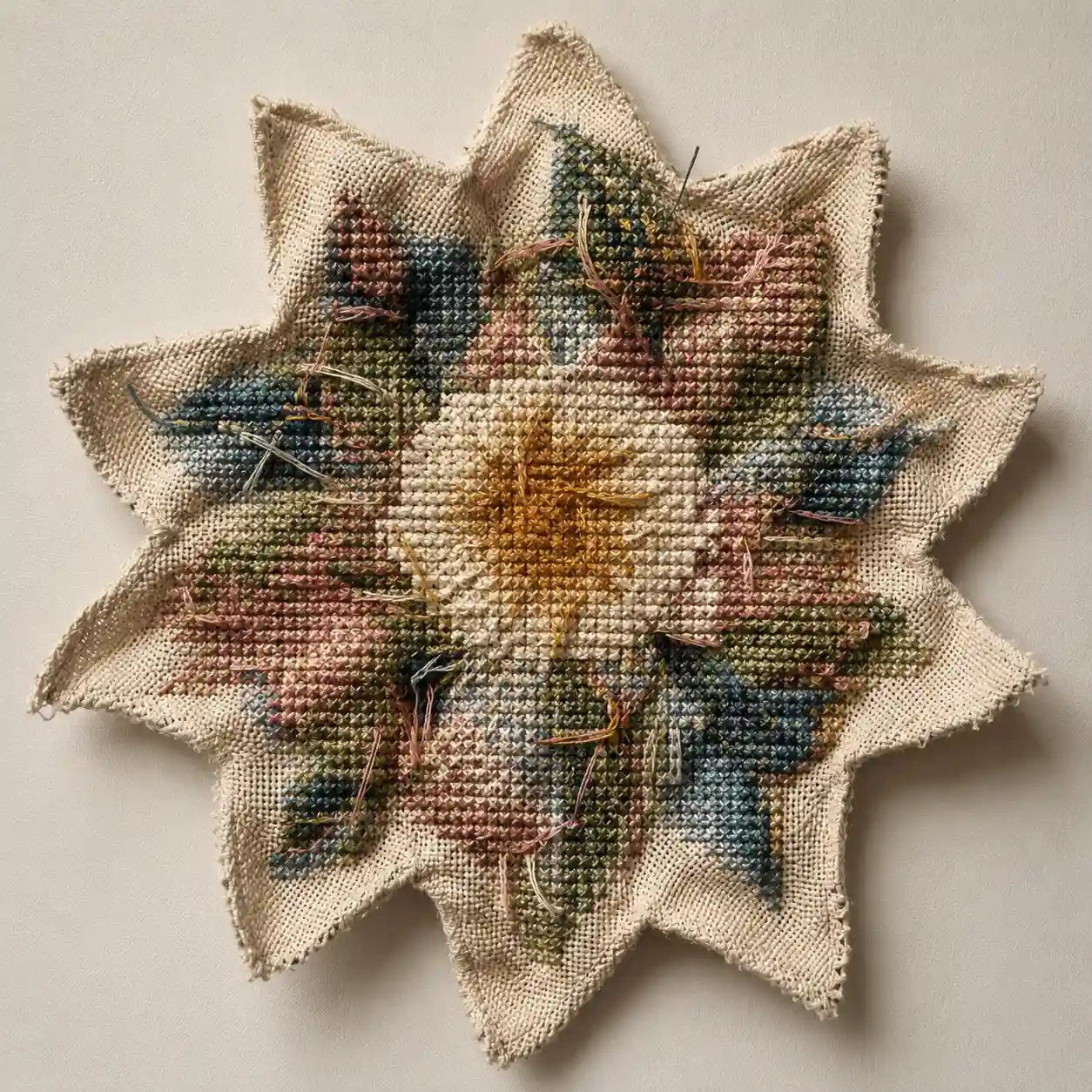
Everything else in this section is still recognizably "a cross-stitch piece" - a sampler, a portrait, a funny phrase, made to be framed, gifted, or hooped and hung. This style asks a different question entirely: what happens when cross-stitch is the material of a fine art practice, shown in a gallery rather than a craft fair, engaging critically with the medium rather than simply using it?
Textile art's long fight for legitimacy
Fiber and textile art has spent decades pushing back against a persistent art-world hierarchy that treated "craft" (textiles, ceramics, needlework) as lesser than "fine art" (painting, sculpture) - a distinction that, historically, tracked suspiciously closely with which mediums were coded feminine and domestic versus masculine and professional. Contemporary fiber artists working in cross-stitch and embroidery are often engaging directly with that history, using a medium literally built from centuries of undervalued domestic women's labor as their subject and material simultaneously.
That makes this style, in a sense, the most self-aware branch of everything covered in this section. Where feminist and political cross-stitch uses the craft to make a statement through its content, gallery-oriented fiber art often makes the medium itself - its history, its associations, its labor - the actual subject of the piece.
Scale, material, and format as the art
Gallery-oriented cross-stitch work frequently breaks conventions the rest of this site treats as fairly fixed: enormous scale rather than a hoop-sized piece, unconventional or reclaimed materials rather than standard Aida or linen, deliberately visible process (loose ends, works in progress, the back of the piece shown alongside the front) rather than a tidy finished object, and installation or sculptural presentation rather than a flat, framed rectangle. The decisions that would count as "mistakes" or breaches of convention in a traditional sampler are often exactly the point here.
You don't need a gallery to think this way
I don't think this style requires an actual gallery show to be worth trying. Even a small, personal piece can borrow this mindset: deliberately breaking a convention you'd otherwise follow without question - an unconventional shape, an unusual material, showing the "wrong" side of the work - is a genuinely useful exercise for understanding which of cross-stitch's rules are technical necessities and which are just inherited habit. That's a question worth asking occasionally, whatever style of piece you're actually making.
Try it: a project idea
Try working outside a standard rectangular hoop or frame entirely - an irregular shape, an unconventional fabric, or a piece meant to be displayed unstretched - as a way of testing where the medium's usual conventions actually come from.