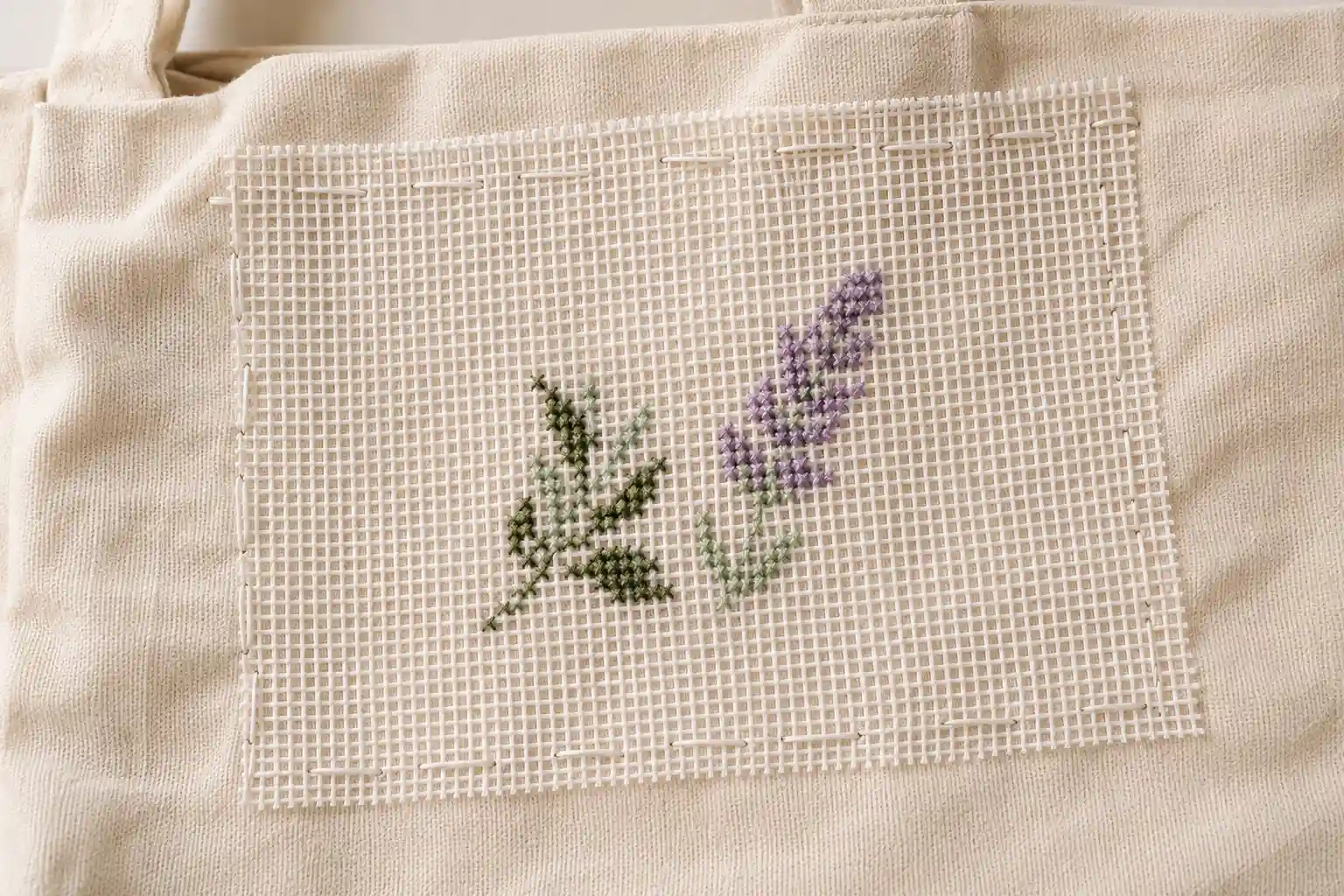
Everything else in this section assumes you're stitching on a countable, evenly-woven fabric - Aida, evenweave, or linen. Waste canvas is the workaround for when you want to cross-stitch onto something that isn't countable at all: a t-shirt, a denim jacket, a tote bag, a towel.
The basic idea
Waste canvas is a stiff, loosely woven, gridded canvas, temporarily basted or pinned on top of your actual fabric. You stitch your design through both layers - the canvas grid and the fabric underneath - using the canvas purely as a counting guide. Once the stitching is done, you dampen the canvas and pull its threads out one by one, leaving your finished cross-stitch sitting directly on the non-countable fabric, with no trace of the canvas remaining. I still find it genuinely satisfying every time I do it - the grid completely disappears and what's left looks like it was somehow stitched directly onto a t-shirt.
Why you need it at all
Fabrics like cotton jersey, denim, or terrycloth have no even, countable thread structure the way Aida or evenweave do - there's no reliable grid to count stitches against, and the weave (or lack of one, for knits) is often too tight, stretchy, or irregular to count by eye at all. Waste canvas solves this by providing a temporary, disposable grid exactly where you need one, then getting out of the way once it's done its job.
How to use it, step by step
- Cut a piece of waste canvas a couple of inches larger than your design on all sides.
- Baste or pin it securely to your project fabric, making sure it's square and won't shift while you stitch - a wandering canvas grid means a wandering, distorted design.
- Stitch your design through both layers as normal, treating the canvas grid exactly like full cross stitch on Aida, counting from the center of your design outward.
- Once finished, trim excess canvas close to the stitching, then thoroughly dampen the canvas with water.
- Once wet, use tweezers to pull the canvas threads out one at a time - they'll slide out cleanly, leaving your stitching intact on the fabric underneath.
A few practical notes
Waste canvas comes in its own range of counts (commonly 6.5, 8.5, 10, 12, 14, and 18) rather than mirroring Aida's counts exactly - pick a count based on the finished stitch size you want, using the same logic as the Aida cloth count guide, just with different numbers on the label. I always baste rather than just pin for anything larger than a small motif - I learned that the hard way on a tote bag where a shifted canvas warped the whole design, and basting is much easier than fixing that after the fact.