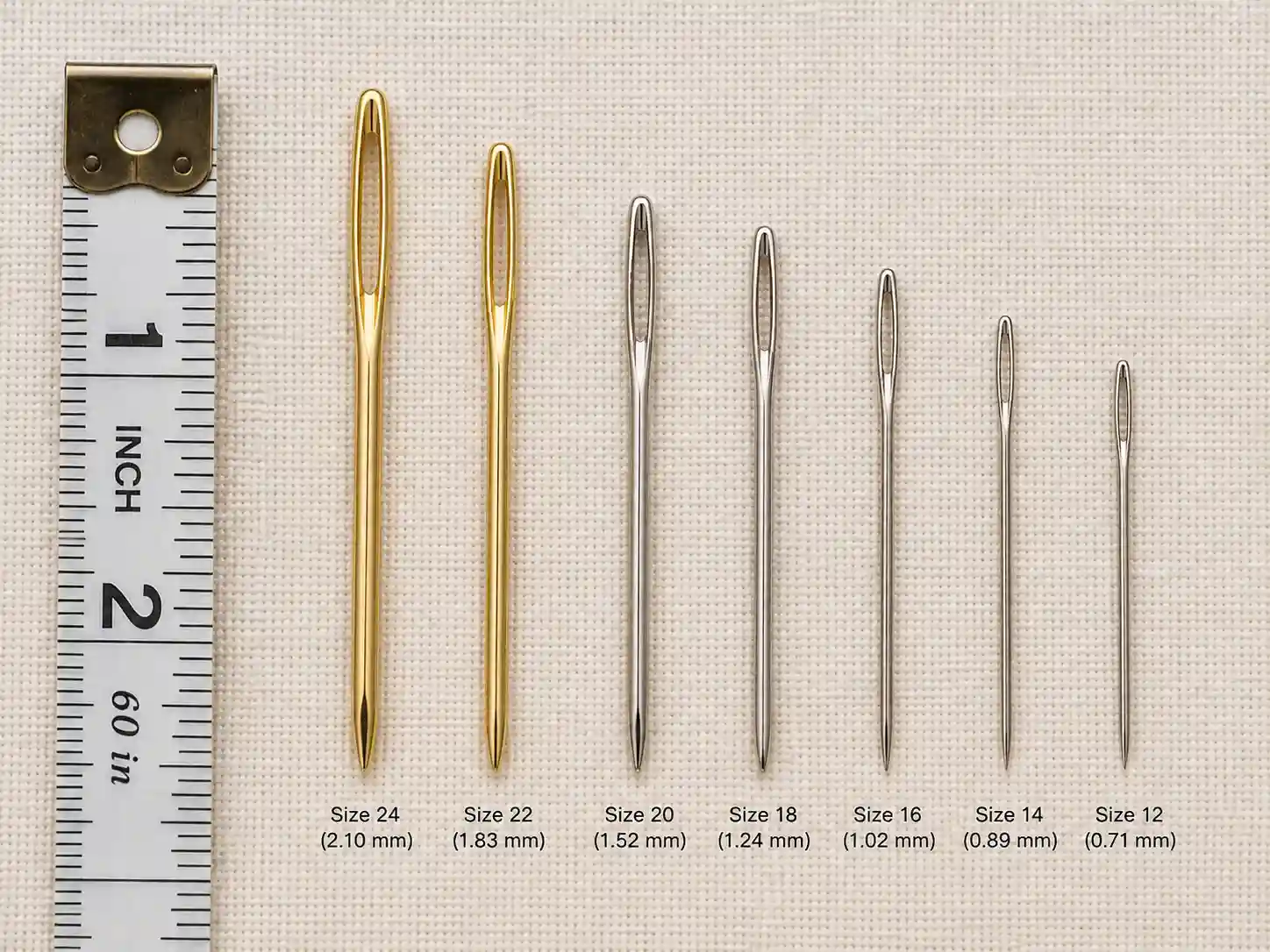
It's a small, easy-to-overlook decision - I ignored it myself for longer than I should have - but the right needle makes cross-stitch noticeably more comfortable, and the wrong one can genuinely distort your fabric or fray your floss. Here's what actually matters.
Blunt tip, not sharp
Cross-stitch needles are tapestry needles: blunt-tipped, with a fairly large, elongated eye. The blunt tip is deliberate - cross-stitch is worked through the existing holes in a countable weave, not by piercing new holes in the fabric, so a sharp point isn't just unnecessary, it's actively unhelpful (a sharp needle is more likely to split fabric threads or snag the tail of a previous stitch). If you've only got sharp embroidery or sewing needles on hand, it's worth picking up a pack of tapestry needles specifically before starting a project.
Sizing, in brief
Tapestry needle sizes run in the opposite direction you might expect: a lower number means a thicker needle, a higher number means a finer one. Size is chosen to match fabric count, since the needle needs to pass easily through the fabric's holes without forcing them wider or, at the other extreme, rattling around loosely:
- Size 22 - pairs well with 11 count Aida
- Size 24 - pairs well with 14 count Aida, and 28-count evenweave or linen worked over two
- Size 26 - pairs well with 16 count Aida, and 32-count evenweave or linen worked over two
- Size 28 - pairs well with 18 and 22 count Aida, and 36-count and finer linen worked over two
These aren't rigid rules - needle choice also depends a little on how many strands of floss you're carrying, since a needle threaded with three strands needs more clearance than one threaded with a single strand.
Signs you've got the wrong size
A needle that's too large for the fabric will visibly distort or stretch the holes as you stitch, sometimes permanently widening them in a way that shows once the piece is finished. A needle that's too small, on the other hand, makes threading awkward and can let the floss twist or fray more than it should as it's dragged repeatedly through a hole that isn't really opened up for it. If your stitches look slightly ragged or the fabric looks stressed around finished stitches, it's worth checking needle size before assuming it's a technique problem.
A note on the eye
Look for a needle with a reasonably large, smooth-edged eye - a cheap or worn needle with a rough or too-small eye edge is one of the most common causes of floss fraying mid-stitch, especially frustrating when you're trying to end a thread cleanly without a knot. It's a small, inexpensive thing to get right, and in my experience it makes a bigger difference to the stitching experience than most beginners expect - myself included, back when I was buying whatever needle happened to be in the kit.