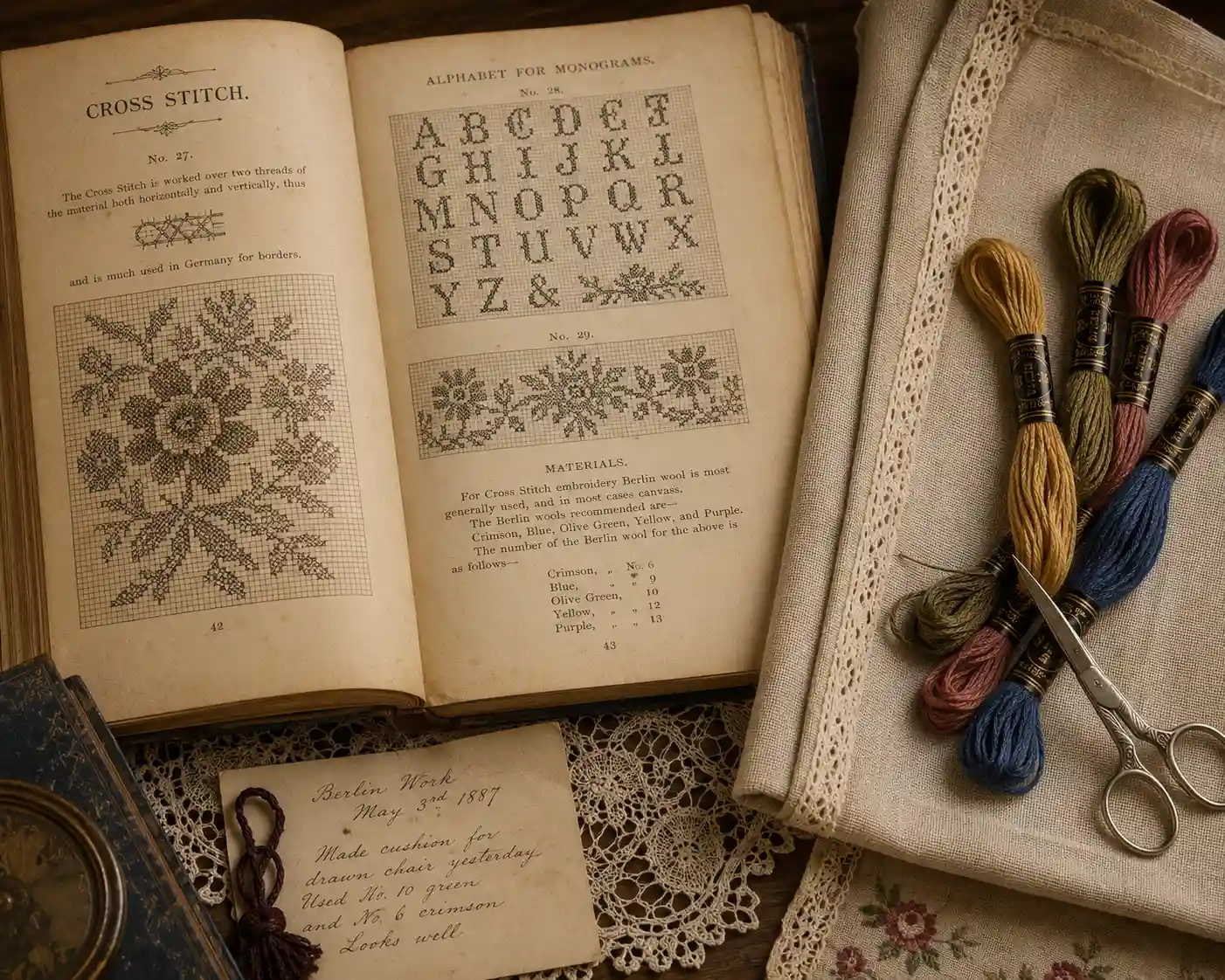
Genuine antique sampler charts and motifs from the era covered in the rise of the sampler and the Victorian revival can be a wonderful, historically grounded source of designs - but "free" and "public domain" aren't automatically the same thing, and it's worth knowing the difference before you build a project around something you found online.
Public domain vs. "free to view"
A chart or motif is genuinely public domain if its copyright has expired (generally true for designs published a very long time ago, well before modern copyright terms) or if the rights holder has explicitly released it that way. That's different from a chart merely being visible online for free - a modern designer's re-drafted or re-colored version of an antique motif, for instance, is typically its own new copyrighted work, even if the underlying centuries-old design it's based on is in the public domain. It's worth checking specifically which situation applies to a source before assuming a free-to-view chart is free to redistribute or sell finished pieces from.
Where genuinely public-domain material tends to live
The most reliable sources for authentic antique sampler and pattern material are generally:
- Museum and library digital collections. Many major museums and national libraries have digitized historical needlework pattern books and sampler photographs as part of their public archives, often explicitly marked with the rights status of each item.
- Out-of-copyright published pattern books. Older embroidery and needlework pattern books, once their copyright term has lapsed, sometimes turn up through public-domain book digitization projects - again, worth checking the specific rights statement for the scan itself, since a library's digitization of an old book can occasionally carry its own separate terms.
- Academic and historical needlework research sites, some of which republish or catalogue antique sampler imagery specifically for study and reference.
I'd deliberately avoid naming specific sites here, since link rot and shifting terms of use mean any list I wrote today could easily be inaccurate by the time you're reading this - a quick search for "[museum name] textile collection" or "public domain sampler archive" alongside the specific era or region you're interested in is a better bet than relying on a fixed list.
Verify each source individually
Because rights status varies file by file, collection by collection, I'd genuinely check each specific source rather than assuming an entire site or archive is uniformly public domain just because part of it is. Look for an explicit rights statement attached to the individual item, not just the site's general "about" page - and when a source's rights status is genuinely unclear, it's safer to treat it as not free to reuse.
Using antique material as inspiration, not just a source
Even where a genuine antique motif is public domain, I'd encourage treating it as a starting point rather than a strict template - see how to design your own traditional-style sampler for how to combine borrowed motifs and borders with your own personal content. That's exactly how the tradition has always worked anyway: motifs were borrowed, recombined, and personalized long before "public domain" was a legal concept at all.