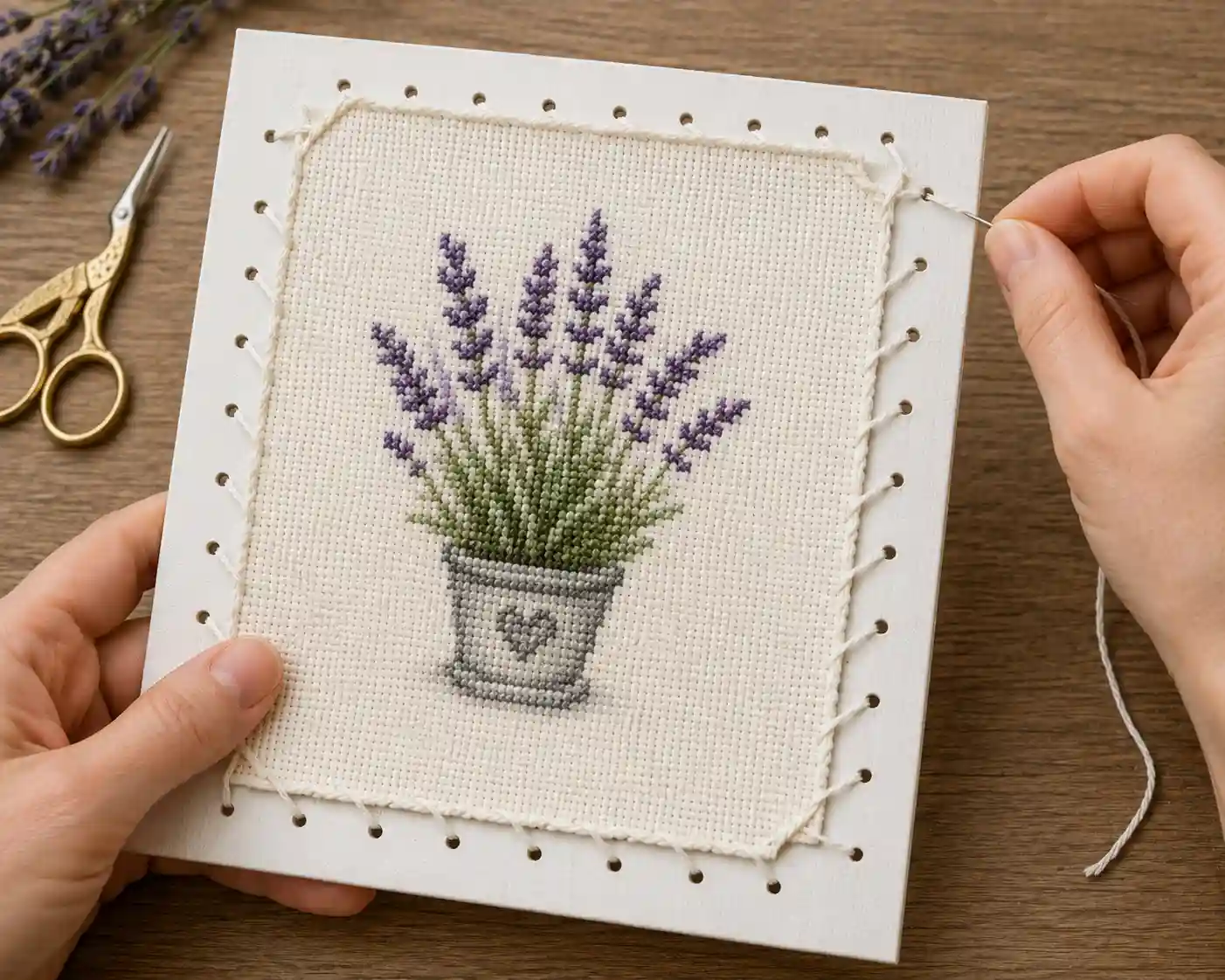
Finishing a stitch is genuinely half the project - a beautifully stitched piece can look amateurish in a bad frame, and a modestly ambitious piece can look genuinely impressive well-mounted. Here's how I think about getting a finished piece from "done stitching" to "ready to hang."
Block and wash first, always
Before you do anything else, block and wash your finished piece - framing a piece that hasn't been blocked will lock in any skew or puckering permanently once it's mounted and can't be corrected later. This step isn't optional if you want a professional-looking result; it's the single biggest factor in whether a framed piece looks crisp or slightly off.
Mounting: lacing vs adhesive
Once blocked, your fabric needs to be mounted taut onto a rigid backing board before it goes into a frame.
- Lacing - the fabric is wrapped around an acid-free foam board or mat board and laced back and forth with strong thread on the reverse, pulling it drum-tight without any glue touching the fabric. This is the archival, reversible method, and the one I'd recommend for anything you'd be upset to lose - a family record sampler, a piece with real sentimental weight, or anything you might want to re-mount differently later.
- Adhesive mounting - the fabric is stretched and fixed to a board with acid-free double-sided tape or spray adhesive. It's faster and easier for a beginner, but it's not reversible, and lower-quality adhesives can yellow or degrade fabric over the years. Fine for a casual, low-stakes piece; I'd avoid it for something meant to last generations.
Choosing glass or no glass
Glazing (glass or acrylic) protects a piece from dust and UV fading but can flatten the texture of the stitches if it sits directly against them - a spacer or mat that holds the glass slightly off the fabric surface preserves the dimensional texture much better than glass pressed flush against it. Non-glare or UV-filtering glass is worth the extra cost for any piece that'll hang somewhere sunny, since floss color genuinely does fade with prolonged direct light exposure.
Mat, or no mat
A mat (a border of card stock between the fabric and the frame's inner edge) does two jobs: it keeps glass off the stitching if you're glazing, and it gives a finished piece visual breathing room, especially valuable for a small or simple design that would otherwise look cramped pressed right up against a frame's edge. For denser, more elaborate pieces - a busy Berlin-woolwork-style design, say - a mat is less necessary, since the piece already fills the space confidently on its own.
When framing isn't the right call
Not every piece wants a traditional frame. A small minimalist design is often better displayed directly in the embroidery hoop it was stitched in, and plenty of modern pieces are finished as something other than a wall-hung rectangle entirely - see finishing ideas beyond framing and gifting and displaying finished cross-stitch for other directions a finished piece can go.